Monday, November 11, 2019

Mary Smith, Daughter of Choctaw Daniel Webster

The story of Mary Smith is one of a woman who petitioned to change her status from that as Choctaw Freedman to that as a Choctaw by Blood. Her father was a Choctaw named Daniel Webster, who was deceased by the time of the Dawes Commission. She as his daughter was seeking status as a Choctaw by Blood, through her father.

National Archives, Ft. Worth Texas
Perry Files #58 Image #4


Mary was enrolled on a card by herself, on Choctaw Freedman Card #230. She was the daughter of Choctaw Daniel Webster, and a Freedwoman, Maria Brown. She resided in the town of Harris, in Red River County. 

National Archives Publication M1186


The name of her father Daniel Webster does appear on the reverse side of the card, and it is noted on the card that he was a Choctaw Indian. But like many with Choctaw and Chickasaw fathers, the evidence was not recorded in detail by the Dawes Commissioner, because of the fact that the mother had been enslaved, thus placing the badge of slavery upon the descendants.

Reverse side of Card


The application jacket of Mary Smith proved to be a large disappointment. There is only one page in the entire file, and it was a simple memorandum that contained Mary's name. There was no interview of Mary, nor of any other person in her file. The words of the interviewer and interviewee are forever lost.


National Archives Publication M1301

The only way to learn more of Mary Smith's story comes from the petition to transfer. On page 5 of the petition to transfer to the roll by blood, it is clear that Mary's fate was determined because it was stated that her name did not appear on any earlier roll of Choctaw Freedmen.

Mary, was born in 1868 and as the child of a Freedwoman, she was considered a Freedman child. The Choctaw Nation did not adopt the Freedmen as citizens until 1885, so it was impossible for her name to have been on a roll of Choctaws by blood when Freedmen had not rights until almost 20 years after her birth. On page 5 of the petition, that is the reason given to exclude her from the rolls of Choctaw by blood. However, the descendants of Mary Smith have clear evidence, that Mary, was the child of h er father, and thus had the blood of her Choctaw father.


Sunday, November 10, 2019

Vicey Moses and Son

The case of Vicey Moses involves that of a woman seeking to be enrolled as an inter-married citizen, and for her son Benjamin to be enrolled as a Choctaw by Blood. She was originally enrolled as a Chickasaw Freedman, but later sought to see if her status could be changed within the category as a Choctaw citizen. Her son, Benjamin who was now married would also have his status adjusted to reflect the blood status coming from his father.

Perry File #242  Image 9


In the file the words of Vicey are found. She points out that her mother is half Choctaw, and she herself was married to Choctaw Charles Moses. During the enrollment process, her husband Charles had tried to have her enrolled as an inter-married citizen, but was told that he could not enroll her as a Choctaw by inter-marriage. This ruling also meant that their son Benjamin, adult and with his own family, could not be enrolled as a Choctaw by blood. Despite having the blood of his father, he was to remain on the records as a Chickasaw Freedman.

Perry File  Image 10

Perry Files  Image 11


The enrollment card of Vicey and son Benjamin are found on Chickasaw Freedman card number 794. Her status based on the tie to Chickasaw slave holder Elvira Willis.

National Archives Publication M1186
Chickasaw Freedmen Card #794


The reverse side reflects the Willis slave holder connection to Vicey's parents Anderson and Malinda. They were enslaved by Hamp Willis.

Reverse side of card


The information provided in her petition clearly outweigh the small and insignificant interview placed in her file by the Dawes Commissioners, where a simply one sentence statement was placed in the file, and not the exact words spoken by Vicey.

National Archives Publication #M1301


In spite of the short and abbreviated summary for her interview, a series of letters are found in the file that actually reflect Vicey's efforts to change her status and that of her son, Benjamin. However, it was ruled that she mentioned that she had been a slave of Elvira Willis. It was also pointed out that there was another marriage that occurred for Charles Moses with another freedwoman. One child was a result of that marriage. 

Additional Document Found in File

Clearly, the value of looking beyond the Dawes Rolls is evident. The details around some of the sparse information is revealed, and also the treatment of African ancestored Choctaws and Chickasaws was evident. Once slavery was a part of the person's history, slavery would forever be the marker placed upon them. Their status could not be changed, nor could the children claim the blood right of their father. Benjamin Moses was Choctaw, and truly carried the blood of his Indian father.


Saturday, November 9, 2019

Family of Katie and Martin Wilson

The story of the Wilson family comes from both Chickasaw and Choctaw Nations. Katie Wilson made an appeal to have her children removed from the rolls of Choctaw Freedmen to that of Chickasaws by Blood. She was married to an Indian and was seeking to have the children enrolled with their father who was then deceased. Her children possesed the blood of their father, and her goal was to have her family enrolled as one family unit--she seeking status as an inter-married citizen, and her children as Chickasaws by Blood. The first few pages from her petition to transfer tells part of the story.


National Archives, Ft. Worth Texas
Perry Files Image #2


A bit more unfolds in subsequent pages. She and her Indian husband were married, officially, and as she put it, conformed to the laws of the nation at that time.

National Archives, Ft. Worth Texas
Perry Files #240 Image #3


Examination of her Dawes card, however, reflects something different, and it might make a researcher think differently. It appears that Katie was the one enrolling her children and grandchildren at the Dawes commission hearing. A tremendous amount of information is collected and recorded, including the name of the Choctaw slaveholder.


National Archives Publication M1186
Choctaw Freedman Card #1057


The reverse side of the card reveals additional family information including the fact that her husband Martin was a Chickasaw.
Reverse side of Card

With all of the data reflected on the enrollment card, it is a bit odd that the official "interview" placed in the file of Katie Wilson only contained on sentence said to have been made by Katie.  The one sentence simply said that she was a slave and belonged to Sam Colbert and that she always lived in the Territory.  The one sentence alone, placed by the stenographer to the Dawes commission might make the tenacious researcher realize that the story was clearly more involved than was presented in the file. 


National Archives Publication M1301


Finally the real "voice" of Katie is heard. She speaks about her life, her marriage, her children and hear grandchildren. It is revealed that she herself did not go to register at the Dawes Commission, but her husband handled their enrollment. He returned from Atoka where he went to enroll, and told her the outcome of the process. He was enrolled as Chickasaw by blood while she and the children were enrolled as Choctaw Freedmen. He told her that nothing could be done about it and to keep quiet about it.

This status as Freedmen for herself and her children did not settle well with her and she sought advice from a family member. Her father encouraged her to have the family transferred to the proper roll. She also pointed out that she herself was half Indian being both Choctaw and Creek.

Perry Files Image #5

Perry Files Image #6


The most enlightening testimony in Katie Wilson's case came from her father, Edmund Perry. He told the story of his daughter's marriage to Martin Wilson who was half Chickasaw and half Choctaw. He spoke of their marriage at his home, and who performed the marriage. He also spoke about his own mixed parentage as well providing even more information about this Freedmen family with strong ties to both tribes.


In spite of it all, the case, was denied, however, the story of Katie Wilson is that of a woman who sought to have the story of her children told correctly. She fought for the rights of her children. Though her battle was lost the records remain and her children and her descendants can all rightfully state through these records that they---the Wilsons and Browns indeed had the blood of their Indian fathers. Their legacy is strong.

Friday, November 8, 2019

Pink and Lucy Thompson Family

From Doaksville in the Chickasaw Nation, the family of Pink and Lucy Thompson appeared in front of the Dawes Commission. The year was 1899 and Pink spoke on behalf of the family. They were Pink and Lucy, their daughter Emma, four sons, Eddie, Walter, Jimmie and Freedman, and a grandchild Lyinz Hampton. They were placed on the Freedmen Rolls nad were thus eligible for land allotments.

However, by 1902  Pink Thompson made submit a request to have his children removed from the Freedman rolls and moved to that of Choctaws by blood. It was pointed out that his wife Lucy, was the daughter of Billy Fall who was a full blood, Choctaw. It was pointed out that he always acknowledged that Lucy was  his daughter, that he had with his enslaved woman Mary Sifac. With this acknowledgement of Lucy's tie to her father, her children should have been eligible for the same treatment as others who were the children of their native fathers.


National Archives, Ft. Woth, Texas
Perry Files, File #22  Image #1


Same source, image #2


The Thompsons were originally placed on a Chickasaw Freedman card, #D29, The same data was later recorded when they were moved form the Doubtful list to an standard card of Choctaw Freedmen #1224.


National Archives Publication M1186
Chickasaw Freedmen #1136 (Cancelled Card)

Reverse side of card

The basic questions posed by the Dawes Commission focused almost exclusively of the enslavement of the family by Chickasaws, and not about any blood tie or relationship of Lucy, to her parents. There was also questioning about the Chickasaw slave owning family, but not of Lucy's relationship to her Choctaw father.

National Archives Publication M1301


Same source as above


In spite of their ties to a Choctaw by blood, Pink and Lucy Thompson and their children all remained on the Freedmen roll. She was the daughter of her Indian father.

National Archives Publication M1186
Official Choctaw Freedman Enrollment Card #1224

Thursday, November 7, 2019

Lela (Lelar) Robbins, of the Johnson, Turnbull Choctaw Families

A complicated case emerges with that of Lela (Lelar) of Sawyer, I. T. She was the daughter of Jerusha Johnson, who was said to have been a mixed blood Choctaw woman of white, Negro and Choctaw blood. Jerusha descended  from Flab Turnbull, a full blood Choctaw citizen, and she was the daughter of Joanna Record, who was admitted as a Freedman.

National Archives, Ft. Worth, Texas
Perry Files, Image #1


National Archives, Ft. Worth, Texas
Perry Files Image #2


The experience of the family was clearly a complicated one as they were originally placed on a Doubtful Card #D29. The matriarch of the family at the time was Joanna Record. Lelar was the daughter of Jerusha Jane Johnson, who was the daughter of Joanna Record, thus making Joanna, Lelar's grandmother.

Because some were not on earlier rolls they were first placed on the Doubtful cards. Eventually however, Joanna and son Newton were placed on their own  card together. The other grandchildren (with the exception of Lela (Lelar) were eventually approved for enrollment. However, Lela remained in a category of being doubted, and then later denied.

National Archives Publication M1186
Choctaw Freedman Card #D29


Reverse side of card


Joanna and son Newton were placed on their own card together. Other grandchildren were placed on a separate card, but Lela who appeared on the original doubtful card was not approved as a Choctaw Freedman. 


Choctaw Freedman Card #1545

The result of this omission was clearly the inclusion of her name challenging the original Dawes Commission decision. And within this challenge came the more detailed and rich family history omitted in the Dawes "official" interview. The questions posed to Joanna did mention grandchildren, but not Lela, and subsequently she had to then struggle to be included. 


National Archives Publication M1301
Excerpt from the file of Joanna Record
File #D29

Thankfully, in her challenges to the original decisions made by the Commission, the issue of her blood ties to the Choctaw community by blood was revealed. Her children and grandchildren, have the legacy documented back several generations, connecting them to the nation of origin from Indian Territory.


Wednesday, November 6, 2019

Lorenzo Russell son of James Russell


Lorenzo Russell's story began originally as a Chickasaw Freedman when his name and that of his wife were put on Chickasaw Freedman card #1306. However they were later placed on a Choctaw Nation Card #1364. He was the son of Choctaw James Russell, and his "Negro" mother Julia.

National Archives, Ft. Worth Texas
Perry Files, File #12, Image #2


Both Lorenzo and wife Mattie had previously been listed on the 1896 Choctaw Roll, and thus were later placed correctly among Choctaw citizens. However, upon examination of the reverse side of the card, he clearly indicates who his Choctaw father was.

National Archives Publication M1186
Choctaw Freedman Card #1364

Reverse Side of Card

It is clear, however, that the commissioners of the Dawes enrollment process were not eager to record data about any Choctaw parents if it was evident that the other parent had been enslaved. With Lorenzo's application, the questions from the commissioners focused on the enslavement of his mother Julia, and nothing was recorded officially about his Choctaw father, James.


National Archives Publication M1301

Julia and James Russell were a married couple, and Lorenzo clearly pointed that out during the process when sought to be transferred to the blood rolls. In addition, James Russell, Lorenzo's father, was living at the time of enrollment, and therefore was placed on his own enrollment card. His name appears on  Choctaw Card #1545. James Russell's parents (Lorenzo's grandparents) were John Russell, and Sallie Russell. 

National Archives Publication M1186, Choctaw Card #1545
Card of Lorenzo's father James Russell

And Lorenzo's mother Julia, was on her own card separately as a Choctaw Freedman. Because her slaveholders were said to be Chickasaw, they did not record the slave holder's name and simply put down "Chickasaw Indian" as slaveholder. She was later moved to a Freedman card, most likely because of her marriage to a Choctaw by blood.

National Archives Publication M1186, Choctaw Freedman Card #1363
Card Of Lorenzo's mother Julia Russell

Children get half of their ancestry from each parent, and the prevailing practice was to put persons of Indian blood on the blood roll. Yet is it is clear that if one had a parent who was a Freedman, then their blood did not count and was not considered of value for their recognition as blood citizens in the tribal nation of their birth. The lived in the nation, practiced the culture and spoke the language, but like Lorenzo Russel, and many more---their blood tie did not matter.

But because of these records that remain, these are those who had the blood of their Indian fathers---and whose names can be spoken together with their fathers, despite the effort to strip them of their identity. Hopefully the descendants of the Russell's still call their names.

Tuesday, November 5, 2019

Alexander Fisher Son of His Father

National Archives, Ft. Worth
Perry Files: File #7, Image #7

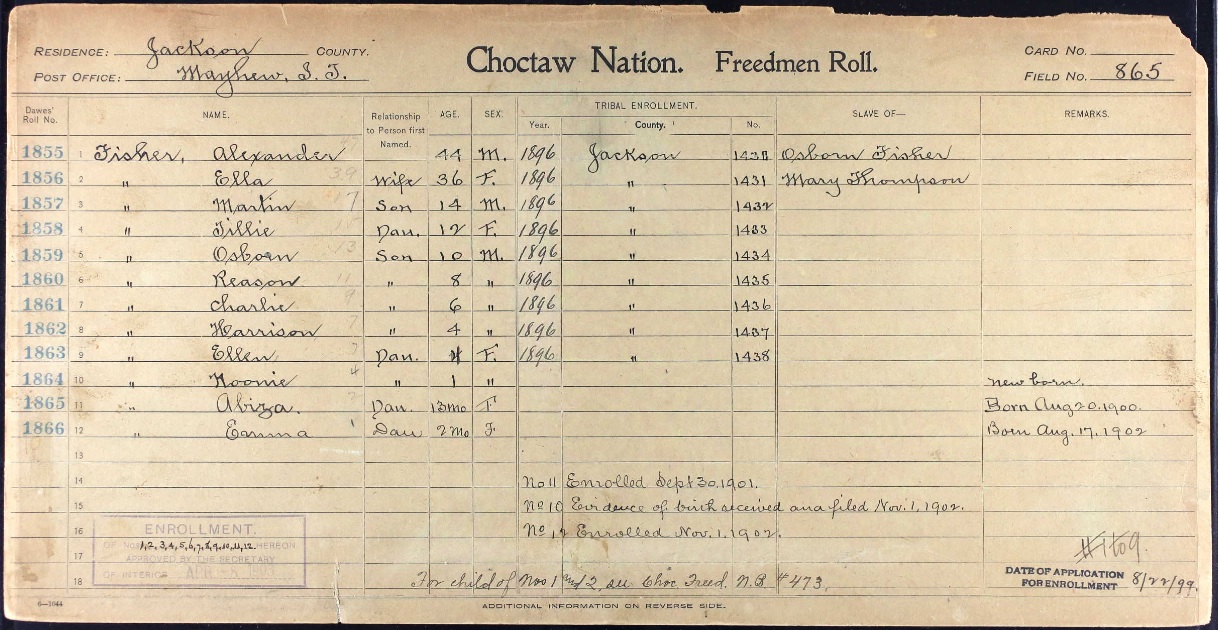
From Mayhew, in the Choctaw Nation, Alexander Fisher appeared in front of the Dawes Commission in 1899. He represented himself and his family. 


National Archives Publication M1186, Choctaw Freedman Card #865


Reverse side of card


Clearly with the knowledge of his family history in detail. it is amazing how short his "official" Dawes interview actually was. Clearly this was a summarized statement and not a true interview. The actual words spoken by Alexander Fisher are not provided in the file.

National Archives, Publication M1901


Cases such as that of Alexander Fisher reflect the effort of the commissioners to ignore the detail that was brought out later when they sought to be removed from Freedman status to that a citizen by blood. Without these records and the challenges that they made the researcher would not know.

And, in spite of the detail that they had to provide---the actual words stated by these families, are still lost. Nevertheless, vital information, some of which goes back two and even three generations is present. The result is that more of their stories can still be gleaned. The tie that the Fisher family had to the Choctaw Fisher family is clear, and with this extra data more of the story can be told.