Showing posts with label Choctaw By Blood. Show all posts

Tuesday, November 26, 2019

Willie Mills and Sister Cora Everidge

In 1906 Willie Mills approached the Commission to the Five Civilized Tribes to have his name and that of his sister Cora, transferred from the Choctaw Freedman Roll, to the Choctaw Roll by Blood. He had a strong knowledge of his lineage, and presented several generations to explain his history to the commission. Willie was the son of Daniel Mills and an enslaved woman Rosanna, held in bondage by George Hawkins. His father Daniel, was the son of Delia, who was a daughter of Zattic LeFlore who was a recognized Choctaw. His recitation of his family lineage is a four-generation pedigree.

National Archives, Ft. Worth Texas
File Number 68 Image #5

At the time of enrollment, his mother Rosanna was still living, and presented information to the Dawes Commission. She was Previously enslaved by George Hawkins and thus, her name and that of her children, were placed on Choctaw Freedman Card Number 558,


National Archives Publication M1186
Choctaw Freedmen Card #558

Rosanna's father (Willie's grandfather) was Jim Mills who was once enslaved by Basil LeFlore, a very well known Choctaw. Her mother was Anna Hawkins, of Kiamitia, an enslaved woman, helf in bondage also by George Hawkins.

Reverse side of card

In the official interview that accompanies File #558, Rosanna, the mother to Willie and Cora was the person interviewed. In that interview, the surname of the slave holding family was noted as Harkins. That surname is actually quite prominent in the Choctaw Nation, and was most likely the true surname. The focus however, was strictly, on their enslavement, and not on their family ties.

National Archives Publication M1301
Interview in Choctaw Freedman File 558


The Commissioners were not taking the claim of Willie Mills seriously and tried to dismiss it claiming that he had never submitted an application by blood to the Choctaw Nation. In addition the explanation that the man alleged to be his great grandfather, Zadoc Le Flore was on the 1885 roll and was born in 1874 and could not have been his great grandfather.

However---the commissioners chose not to acknowledge Willie's family ties to the Le Flores---the Choctaw Le Flore family. Willie's grandfather Jim Mills was enslaved by Basil LeFlore. And Basil LeFlore was one of the most prominent men in the Choctaw Nation. Basil LeFlore had a son, Zadoc LeFlore who was born in 1848 in the Pushmataha district of the Choctaw Nation. He would have been of age to have fathered a child in the 1870s. In fact--that would have been the very same Zadoc-Zattick whom he mentioned. Even if the commission had found the same Zadoc on the 1885 roll, it was considered immaterial, as were ohter cases of those of African ancestry seeking to be transferred.

Perry Files Image #6

The rationale was always the same---they Willie, his father, or grandfather, were never on a roll previously. Of course such enrollment was not allowed, as those formerly enslaved people were prevented from citizenship in earlier years.

However---the descendants of Willie Mills and Cora Everidge can still speak to their history and their legacy. They are the children of Daniel Mills, the son of Delia, who was the daughter of Zadoc, who was the son of Basil LeFlore. They are the descendants of their Choctaw fathers.

Saturday, November 23, 2019

Ben Stevenson and his Choctaw Legacy

The story of Ben Stevenson reflects a man claiming for himself and his children, their ancestry,  in the nation of their birth---the Choctaw Nation. The case is a fascinating one taking his history back through several generations connecting to their Choctaw line. The children Malinda, Jake, and Garfield were the children of Ben Stevenson who was the son of  his father, Cornelius Stevenson. Cornelius who was quarter blood Choctaw, was the son of Laney Colbert who was half Choctaw. And she was the daughter of James Colbert a recognized Choctaw, who had always recognized her as his daughter. Five generations are reflected in this family, and thus a rich family legacy is found.


National Archives, Ft. Worth Texas
Perry Files: File Number 234  Image #2


Same document


Originally during the time of the Dawes enrollment Ben Stevenson's name was placed on an enrollment card with no other names. The names of his wife and children were placed on Chickasaw Freedman Card, number 424. Because he was born before the end of the Civil War, the name of the slave holder was also recorded on the card, Susie Colbert.


National Archives Publication M1186
Choctaw Freedman Card, #159

Cornelius Stevenson was Ben's father and his mother was Viney Williams

Reverse side of card

Clearly Ben Stevenson's case is one where there actions of the Commission, were clear. No real interview remains in his file. Merely a 1-sentence statement is placed there, and the substantive dialogue that may have unfolded was discarded. If he spoke at that time, to his parentage and progenitors, it was stricken from the file.


Interview Summary from Application Jacket


The policy was clear---when one of African ancestry was speaking--- the policy was simply to determine the name of the slave owner and place that person and his family on the Freedmen roll and not the roll by blood.

Essentially the message was clear to the former slaves---the message was that their blood did not count. The message from the Commission and endorsed by the tribes to this day was that they were somehow "tainted" with a past that involved slavery---a condition for which they never asked, but for which they would be punished for decades. And today---that policy continues through the act of exclusion from enrollment.

However, the descendants of Ben and Lizzie Stevenson can still speak to their history. Malinda, Jake and Garfield were the children of Ben and Lizzie. Ben was the son of Cornelius, who was the son of Laney who was the daughter of James Colbert, her Choctaw father.

Friday, November 22, 2019

Isom and Julia Jackson and Family

The history of Isom and Julia Jackson is complex and fascinating to study. Isom and wife Julia were initially enrolled as Chickasaw Freedmen, but were later transferred to the Choctaw Freedmen  Roll. Later, in 1906, Julia (along with others) sought to have her name transferred to that of Choctaws by Blood.

National Archives Ft. Worth Texas
Perry Files: File Number 66, Image #15

The names of Isom and Julia Ann Jackson, were placed on Choctaw Freedmen Roll #1213. Interestingly both were in their fifties at the time and had both been enslaved, yet the name of their former slave holder was not reflected on their Freedman card.


National Archives Publication M1186
Choctaw Freedman Card #1213

The reverse side of the card, does reflect the names of their parents, and the names of the slave holder of each parent is reflected.

Reverse side of card

In contrast is the original Chickasaw Freedman card where their names were first placed, and this time, instead of the name of the slave holder, simply the word, "Chickasaw" appears on the card.


National Archives Publication M1186
Chickasaw Freedman Card #1124

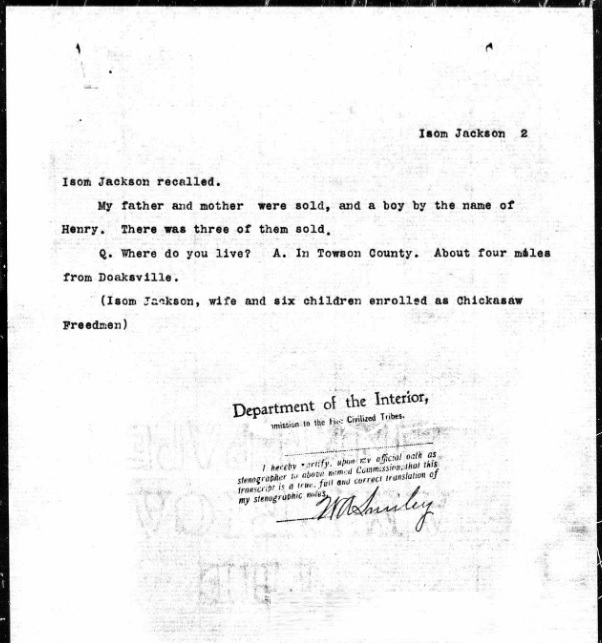
The Dawes Interview for Isom and Julia Ann Jackson focuses almost exclusively on the history of Isom and in no way reflects Julia's parents or status while enslaved. It is also revealed that Isom's parents were eventually sold before freedom came.


National Archives Publication M1301
File for Choctaw Freedman Card #1213

Same source


Also included in the file was a document transferred from the original Chickasaw file, again pertaining to Isom's parentage.


Same Source. Image transferred from old Chickasaw Card #1124


In the petition to transfer to the rolls by blood Julia states that she was the daughter of a known Choctaw by the name of Ben Gilbert. The petition and the examining commissioners noted that the name of the father Ben Gilbert was not on any roll of recognized Choctaws by Blood.

Previous Rolls:
  The earlier rolls that were used in the Dawes process, for Choctaw citizens was the 1896 roll. A random search of several approved Choctaws on the Blood roll often referenced this one roll, as seen on the next two images.

National Archives publication M1186
Randomly selected Choctaw by Blood Card


Same source as above


So, the previous roll upon which a person's name would be checked would have been this roll. With the possibility that the parent named died prior to 1896, it is clear that their name would not have been on any roll as stated.

Julia's father's lineage

There is a challenge to Julia's case, that centers around the name of her father. On the enrollment card, it is noted that her father's name was Ben McGilbry. But in the petition that she submitted in 1906 it is noted that she is the daughter of Ben Gilbert, who was the son of John Gilbert a recognized Choctaw.  It is clear from the interview that Isom, her husband was the one speaking and not Julia herself. It is quite possible that Isom could have misspoken the name of Julia's father and that could have been the source of the discrepancy. 

There is another possibility for the discrepancy--there is a similarity of sound,  between "Gilbert" and "McGilbry" is significant. If one states the name of McGilbry incorrectly, or quickly,  the listener, could conceivably hear the name differently from the way it was pronounced. Nevertheless in the petition, it is Julia' petition--thus Julia Ann's voice that is reflected. And she, more than her husband can correctly identify her father.

In the petition, she points out that Ben Gilbert was her father. Ben Gilbert was the son of the recognized  Choctaw John Gilbert. Julia's blood tie to Choctaws comes through her father and grandfather John. Julia herself was born about 1848. Her father John would have been born in the 1830s and her grandfather John would have been born in the very early 1800s years before removal. As a result--grandfather John would  not have been on any Choctaw roll from Indian Territory. But the possibility her knowing what her grandmother--the enslaved woman Mahaley would have passed down to son Ben, is high.

The children of Isom and Julia Ann Jackson can still honor their history and their heritage, as they descend from John, and carry the blood of their Choctaw progenitor, through Ben, the son of his Choctaw father.


Thursday, November 21, 2019

Jordan Folsom, Son of Choctaw Henry Folsom

Jordon Folsom of Ft. Towson, lived in the Doaksville area of Indian Territory, and in 1906 he requested that his name be transferred to the roll of Choctaws by blood. His father was a known Choctaw named Henry Folsom. His mother was a former slave called Sylvia, with whom, his father Henry had a relationship, resulting in his son, Jordon.


National Archives, Ft. Worth, TX

Perry Files: File Number 28  Image #1

From the Dawes card it is noticed that he was enslaved by Henry Folsom. Jordan's name is found on Choctaw Freedman card #1209. His wife Amelia was enrolled on a separate Choctaw Freedman card.


National Archives Publication M1186
Choctaw Freedman Card 1209

He identified that Henry Folsom was also his father, and his mother Silvey, his mother, was also indicated on the back side o the card. He also pointed out that Henry, his father was Choctaw, and it is so indicated on his card.

Reverse side of card

The interviews are always interesting to read, even though they are not verbatim transcriptions. In this case only the slavery history is what is written down and later typed as part of the final file. Clearly he had to have been asked about his father and if his father was ever a slave, because the data was entered on the enrollment card, above. But the official interview place in the file, focused exclusively on the status of being enslaved, rather than the family connection, between Jordan, and his father.

National Archives Publication M1301

With many of these interviews, it is often pointed out that there was never an application for enrollment by blood, made by the petitioner. In this case as in other cases, it is stated that the petitioner never applied to be placed on the rolls by blood, and his name was never previously on a roll of Choctaws by blood. Yet, the Choctaw Nation did not give citizenship to their former slaves until the 1880s so such enrollment would never have been possible. In addition, Henry Folsom, Jordan's father, was long deceased, so his name also was never on a roll made subsequent to his death. Henry Folsom's status as a slave holder was never doubted, nor challenged, Henry's status was as a citizen was questioned only when the Freedman son, requested to be transferred to the blood roll. Such reasons were going to be used against this application, and his request was denied.

However, it is imperative that the descendants of Jordon and Amelia Folsom speak to their history, and their ancestor Jordon, who was the son of his Choctaw father.


Wednesday, November 6, 2019

Lorenzo Russell son of James Russell


Lorenzo Russell's story began originally as a Chickasaw Freedman when his name and that of his wife were put on Chickasaw Freedman card #1306. However they were later placed on a Choctaw Nation Card #1364. He was the son of Choctaw James Russell, and his "Negro" mother Julia.

National Archives, Ft. Worth Texas
Perry Files, File #12, Image #2


Both Lorenzo and wife Mattie had previously been listed on the 1896 Choctaw Roll, and thus were later placed correctly among Choctaw citizens. However, upon examination of the reverse side of the card, he clearly indicates who his Choctaw father was.

National Archives Publication M1186
Choctaw Freedman Card #1364

Reverse Side of Card

It is clear, however, that the commissioners of the Dawes enrollment process were not eager to record data about any Choctaw parents if it was evident that the other parent had been enslaved. With Lorenzo's application, the questions from the commissioners focused on the enslavement of his mother Julia, and nothing was recorded officially about his Choctaw father, James.


National Archives Publication M1301

Julia and James Russell were a married couple, and Lorenzo clearly pointed that out during the process when sought to be transferred to the blood rolls. In addition, James Russell, Lorenzo's father, was living at the time of enrollment, and therefore was placed on his own enrollment card. His name appears on  Choctaw Card #1545. James Russell's parents (Lorenzo's grandparents) were John Russell, and Sallie Russell. 

National Archives Publication M1186, Choctaw Card #1545
Card of Lorenzo's father James Russell

And Lorenzo's mother Julia, was on her own card separately as a Choctaw Freedman. Because her slaveholders were said to be Chickasaw, they did not record the slave holder's name and simply put down "Chickasaw Indian" as slaveholder. She was later moved to a Freedman card, most likely because of her marriage to a Choctaw by blood.


National Archives Publication M1186, Choctaw Freedman Card #1363
Card Of Lorenzo's mother Julia Russell

Children get half of their ancestry from each parent, and the prevailing practice was to put persons of Indian blood on the blood roll. Yet is it is clear that if one had a parent who was a Freedman, then their blood did not count and was not considered of value for their recognition as blood citizens in the tribal nation of their birth. The lived in the nation, practiced the culture and spoke the language, but like Lorenzo Russel, and many more---their blood tie did not matter.

But because of these records that remain, these are those who had the blood of their Indian fathers---and whose names can be spoken together with their fathers, despite the effort to strip them of their identity. Hopefully the descendants of the Russell's still call their names.