Showing posts with label Choctaw Freedman. Show all posts

Tuesday, October 19, 2021

New Choctaw & Chickasaw Freedmen Group Makes a Splash on Social Media

 The new organization, Choctaw Chickasaw Freedmen Association has made a splash on Social Media. The new group announced its presence first on Facebook and also with a detailed press release. The new website CCFANow.org came live at the same time and much needed energy has been injected into the community of descendants from both Oklahoma-based federally recognized tribes.

The Facebook page for Choctaw and Chickasaw Freedmen has over 1000 members, and many are now frequenting the new CCFA website for links to pages reflecting their history and their ancestral culture. In addition, a new Instagram page has been created with rich information not only about the new group, but also with useful links to contemporary issues pertaining to Freedmen.


The brainchild of Athena Gaiten Butler, originally of Kansas City Missouri, the group formed a small core group that worked together as a committee to establish, CCFA, the acronym for the group. One of the goals of this new organization is to reach out to Freedmen descendants of both Choctaw and Chickasaw Nations. Although descendants of Freedmen at present do not have citizenship in either nation, descendants of both nations have much in common. Beyond the shared history of their ancestors having once been enlsaved in Indian Territory, their vision extends far beyond a goal of a tribal card.

Some of the goals of CCFA are reflected in their social media presence. CCFA's Instagram account presents history as well as contemporary issues pertaining to both Freedmen communities. Likewise the group also has an accont on Twitter and has had significant Twitter re-tweets to their posts as well.


Much discussion pertaining to CCFA interests stems from much of the activity found on the Facebook page. There are several communities of descendants from both nations, many still living on old land allotments from the past. In addition, many Freedmen descendants also still live within the geographic boundaries of both tribes, while many, especially elders still have a cultural identity to the tribes, despite decades of segregation disenfranchisement and estrangement.

Many Freedman descendants are found on the CCFA Faceboook page, and over 1000 are found on the Descendants group page. Last week on Facebook, in honor of Indigenous Peoples Day, the Descendants group honored the day by honoring their ancestors, and posting images of them and identifying their relationship to their respective nations. Several dozen images were shaared and the reaction to the postings has been extremly positive!

Small Collage of Ancestors Honored on Freedman Facebook Page

On the Facebook Freedman Descendants page, portraits of ancestors were shared, along with the Roll number and Card number. Some who did not have portraits shared images of their ancestor;s Dawes Card. Some elaborated by telling a brief story about their ancestor. Much of this history of various families will be reflected on the website as well as on the pages of social media

Challenges Ahead
Chickasaw Freedmen descendants have  a particularly interesting situation, because the despite the fact that the tribe broke the treaty of 1866, where they promised citizenship for their former slaves, many Freedmen descendants today will still tell others that they are Chickasaw. Likewise, descendants of Choctaw Freedmen also live on land allotments within the geographic jurisdiction of their nation and will tell others that they too, are Choctaw.

Thousands of descendants of both Freedmen groups live "at large" meaning outside of Oklahoma, having had family that migrated north and west. They left seeking more opportunities when the harshness of Oklahoma Jim Crow laws and the appearance of Sundown towns drove them away from the land that was for over a century, their home.

CCFA seeks to educate descendants to their rich history, to interact with those of both nations about the history and culture, and to empower descendants by offering workshops focusing on education, and opportunities for growth. CCFA also hopes to reach out to the community of enrolled Choctaw citizens through cordial meetups, and to encourage social interaction bewteen Freedmen and other fellow Choctaws.

Culturally, many Choctaw Freedmen considers themselves to be among the "Choctaw Proud" or Chickasaw people, and many are unaware that some of their leifestyle, including foodways come from their own their tribal background.

Much of who the freedmen are, will continue to be reflected both on the website and much more is planned to unfold on social media.

Follow CCFA on Facebook, Instagram, and Twitter.


Tuesday, November 26, 2019

Willie Mills and Sister Cora Everidge

In 1906 Willie Mills approached the Commission to the Five Civilized Tribes to have his name and that of his sister Cora, transferred from the Choctaw Freedman Roll, to the Choctaw Roll by Blood. He had a strong knowledge of his lineage, and presented several generations to explain his history to the commission. Willie was the son of Daniel Mills and an enslaved woman Rosanna, held in bondage by George Hawkins. His father Daniel, was the son of Delia, who was a daughter of Zattic LeFlore who was a recognized Choctaw. His recitation of his family lineage is a four-generation pedigree.

National Archives, Ft. Worth Texas
File Number 68 Image #5

At the time of enrollment, his mother Rosanna was still living, and presented information to the Dawes Commission. She was Previously enslaved by George Hawkins and thus, her name and that of her children, were placed on Choctaw Freedman Card Number 558,


National Archives Publication M1186
Choctaw Freedmen Card #558

Rosanna's father (Willie's grandfather) was Jim Mills who was once enslaved by Basil LeFlore, a very well known Choctaw. Her mother was Anna Hawkins, of Kiamitia, an enslaved woman, helf in bondage also by George Hawkins.

Reverse side of card

In the official interview that accompanies File #558, Rosanna, the mother to Willie and Cora was the person interviewed. In that interview, the surname of the slave holding family was noted as Harkins. That surname is actually quite prominent in the Choctaw Nation, and was most likely the true surname. The focus however, was strictly, on their enslavement, and not on their family ties.

National Archives Publication M1301
Interview in Choctaw Freedman File 558


The Commissioners were not taking the claim of Willie Mills seriously and tried to dismiss it claiming that he had never submitted an application by blood to the Choctaw Nation. In addition the explanation that the man alleged to be his great grandfather, Zadoc Le Flore was on the 1885 roll and was born in 1874 and could not have been his great grandfather.

However---the commissioners chose not to acknowledge Willie's family ties to the Le Flores---the Choctaw Le Flore family. Willie's grandfather Jim Mills was enslaved by Basil LeFlore. And Basil LeFlore was one of the most prominent men in the Choctaw Nation. Basil LeFlore had a son, Zadoc LeFlore who was born in 1848 in the Pushmataha district of the Choctaw Nation. He would have been of age to have fathered a child in the 1870s. In fact--that would have been the very same Zadoc-Zattick whom he mentioned. Even if the commission had found the same Zadoc on the 1885 roll, it was considered immaterial, as were ohter cases of those of African ancestry seeking to be transferred.

Perry Files Image #6

The rationale was always the same---they Willie, his father, or grandfather, were never on a roll previously. Of course such enrollment was not allowed, as those formerly enslaved people were prevented from citizenship in earlier years.

However---the descendants of Willie Mills and Cora Everidge can still speak to their history and their legacy. They are the children of Daniel Mills, the son of Delia, who was the daughter of Zadoc, who was the son of Basil LeFlore. They are the descendants of their Choctaw fathers.

Thursday, November 21, 2019

Jordan Folsom, Son of Choctaw Henry Folsom

Jordon Folsom of Ft. Towson, lived in the Doaksville area of Indian Territory, and in 1906 he requested that his name be transferred to the roll of Choctaws by blood. His father was a known Choctaw named Henry Folsom. His mother was a former slave called Sylvia, with whom, his father Henry had a relationship, resulting in his son, Jordon.


National Archives, Ft. Worth, TX

Perry Files: File Number 28  Image #1

From the Dawes card it is noticed that he was enslaved by Henry Folsom. Jordan's name is found on Choctaw Freedman card #1209. His wife Amelia was enrolled on a separate Choctaw Freedman card.


National Archives Publication M1186
Choctaw Freedman Card 1209

He identified that Henry Folsom was also his father, and his mother Silvey, his mother, was also indicated on the back side o the card. He also pointed out that Henry, his father was Choctaw, and it is so indicated on his card.

Reverse side of card

The interviews are always interesting to read, even though they are not verbatim transcriptions. In this case only the slavery history is what is written down and later typed as part of the final file. Clearly he had to have been asked about his father and if his father was ever a slave, because the data was entered on the enrollment card, above. But the official interview place in the file, focused exclusively on the status of being enslaved, rather than the family connection, between Jordan, and his father.

National Archives Publication M1301

With many of these interviews, it is often pointed out that there was never an application for enrollment by blood, made by the petitioner. In this case as in other cases, it is stated that the petitioner never applied to be placed on the rolls by blood, and his name was never previously on a roll of Choctaws by blood. Yet, the Choctaw Nation did not give citizenship to their former slaves until the 1880s so such enrollment would never have been possible. In addition, Henry Folsom, Jordan's father, was long deceased, so his name also was never on a roll made subsequent to his death. Henry Folsom's status as a slave holder was never doubted, nor challenged, Henry's status was as a citizen was questioned only when the Freedman son, requested to be transferred to the blood roll. Such reasons were going to be used against this application, and his request was denied.

However, it is imperative that the descendants of Jordon and Amelia Folsom speak to their history, and their ancestor Jordon, who was the son of his Choctaw father.


Tuesday, November 5, 2019

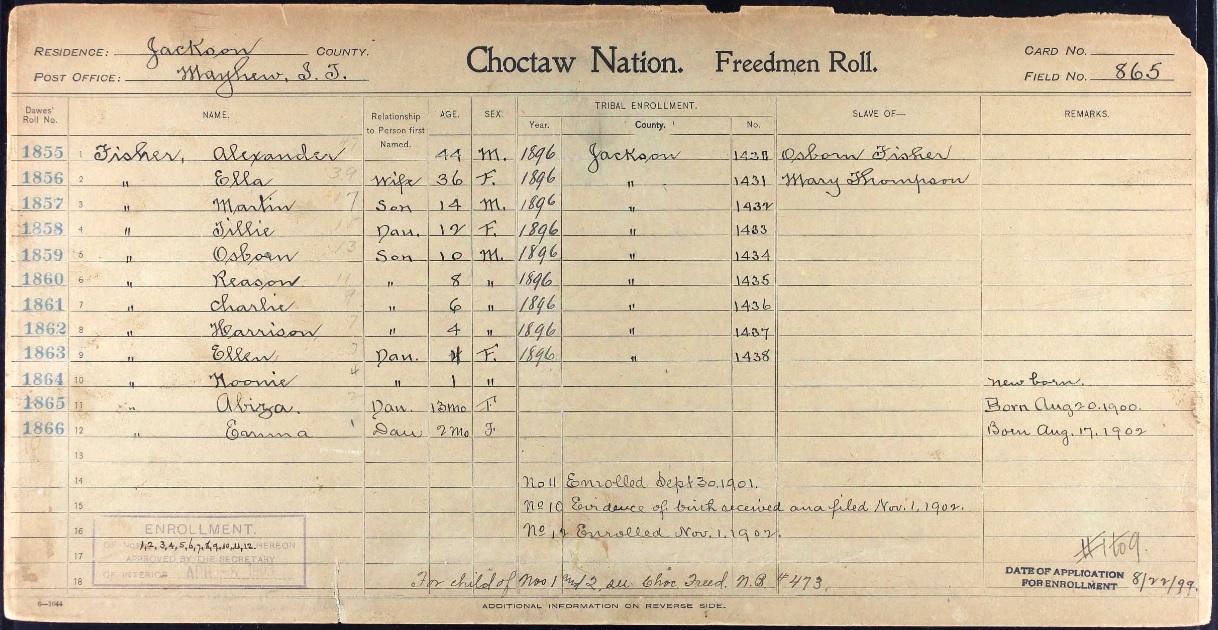
Alexander Fisher Son of His Father

National Archives, Ft. Worth
Perry Files: File #7, Image #7

From Mayhew, in the Choctaw Nation, Alexander Fisher appeared in front of the Dawes Commission in 1899. He represented himself and his family. 


National Archives Publication M1186, Choctaw Freedman Card #865


Reverse side of card


Clearly with the knowledge of his family history in detail. it is amazing how short his "official" Dawes interview actually was. Clearly this was a summarized statement and not a true interview. The actual words spoken by Alexander Fisher are not provided in the file.

National Archives, Publication M1901


Cases such as that of Alexander Fisher reflect the effort of the commissioners to ignore the detail that was brought out later when they sought to be removed from Freedman status to that a citizen by blood. Without these records and the challenges that they made the researcher would not know.

And, in spite of the detail that they had to provide---the actual words stated by these families, are still lost. Nevertheless, vital information, some of which goes back two and even three generations is present. The result is that more of their stories can still be gleaned. The tie that the Fisher family had to the Choctaw Fisher family is clear, and with this extra data more of the story can be told.


Wednesday, February 13, 2019

It is Time to Preserve the Legacy of over 8000 Freedmen

Indian Advocate November 1, 1900
p 154, Image 21
(Article accessed on Chronicling America, Library of Congress)


In 1900, the Indian Advocate ran an article about the population of people in Indian Territory. With 4 of the 5 Civilized Tribes, they included a breakdown with number of Freedmen enumerated in the 1900 Federal Census.

Excluding the Seminole Freedmen, there were 4000 Cherokee Freedmen, 5000 Creek Freedmen, 4150 Choctaw Freedmen, and 4500 Chickasaw Freedmen. This is a total of 17,650 Freedmen from all of the Five Tribes. With Choctaw and Chickasaw Freedmen, there were 8,650 in the two nations combined. Eight thousand people are a significant population to study. In addition, the two populations from both tribes often had strong inter-connected families, through marriage, and by accident of geography.

Choctaw and Chickasaw Freedmen, also joined together to become advocates for their rights in the Territory, and for their respective rights to remain in the nation of their birth. Theirs is a story that deserves to be studied in depth from multiple perspectives, and within multiple disciplines. Historians, anthropologists, sociologists, public policy specialists and independent scholars are needed to devote some time to these two nations, in depth.

The people of both Chickasaw and Choctaw Nations, formed a community of advocates as early as 1866 when Richard Brashears formed the first Freedman gathering in the northern Choctaw Nation in Skullyville. By the 1890s, the Choctaw-Chickasaw Freedmen's Association was active and had an important conference at Dawes Academy, to organize and to bring forth their voices on behalf of the Freedmen.

We are at a critical time, when the memory and legacy of Freedmen from both nations could be forgotten. Initiatives on multiple levels are therefore needed. There are those whose goals are enrollment. That should not however, be the only goal of descendants. Preservation of historic landmarks, towns, cemeteries can be done without tribal support. Research focusing on historical accomplishments, biographies of notable leaders, educators and scholars is sorely needed.

People who numbered in the thousands have a legacy and it is ours to honor, and preserve. Over 8000 Freedmen today have hundreds of thousands of descendants after a century. Therefore, a commitment from the community of descendants is needed. Some have already begun projects, but the time to bring them to light, and to share with the larger community is now.

If you are among those quiet warriors, now is the time to share your work, your passion and your commitment. We cannot let this legacy die.

Share them with the Freedmen community! Honor the ancestors, for it is upon their shoulders that we stand.


Friday, April 15, 2016

In Search of Davis Frazier

"So who the heck is Davis Frazier," I was asked. My reply was simply, "I have no idea, I have never heard of him."

More than 10 years ago, a research colleague, (the noted researcher Tonia Holleman) asked me the question about a man whose draft card she had come across. She was researching men from LeFlore County Oklahoma who were registering for the World War I, Draft. The man whose card she had found was that of Davis Frazier.

Draft card of Davis Frazier, discovered by Tonia Holleman of Van Buren Arkansas.
Many thanks to her for sharing this discovery.
Source: Registration State: Oklahoma; Registration County: Le Flore; Roll: 1851803
Ancestry.com. U.S., World War I Draft Registration Cards, 1917-1918 [database on-line].
Provo, UT, USA: Ancestry.com Operations Inc, 2005
.


The reason why the card caught her attention was the fact that he mentioned my great grandmother Sallie Walton as his next of kin.  So who the heck was Davis Frazier?

She did some research and later pointed out to me that he had a Dawes Card. Surely enough he did, and he, like my great grandmother Sallie was a Choctaw Freedman. He was enrolled around the time that most of the Freedmen from Sugar Loaf County in the Choctaw Nation were enrolled. 

Source: Ancestry.com. Oklahoma and Indian Territory, Dawes Census Cards
for Five Civilized Tribes, 1898-1914
 [database on-line]. Provo, UT, USA: Ancestry.com Operations, Inc., 2014.

Davis Frazier's father was the Choctaw Indian Silas Frazier, of Sugar Loaf. His mother was Indiana Frazier who was a slave in the Perry family. Her slave mistress was Sophia Perry, who was part of the same clan of Perry slave holders connected to my Sallie Walton. I am thankful that she located this information, but still this did not provide much information about the identity of Davis Frazier.

(Source: same as above)

In 2010, I had the opportunity to meet Colin Kelley, a descendant of Nail Perry, and I have kept in touch with him over the years. It was his ancestral family that was connected to my own family--he is a descendant of the Choctaw Perrry's, who were the slave holding Perrys of Sugar Loaf County, Choctaw Nation.  The Perry's were not a wealthy plantation clan, but they were well tied to the Perry's and Folsoms of Sugar Loaf and Skullyville. They were also among the first Choctaws who migrated in 1831 and 1832.

In my own family--the names are fairly well known, Kitty, was the matriarch of my Perry family. Her children, were Jackson, and Amanda, from what I knew at the time. Amanda later gave birth to Sallie, my gr. grandmother in 1863. Sallie's oldest son was my grandfather Samuel. So--who was this Davis Frazier, who had a connection to my family, and who mentioned Sallie Walton as his closest relative?

I wrote an article about part of this line of research in 2012. on my other blog. Looking at the data on the card, Choctaw Silas Frazier his father was deceased by 1899 when Davis applied for the Dawes enrollment process. His mother Indiana was also deceased. However, the connection appeared to be through the Perrys. Sophia was part of the Perry clan. So, if Indiana was his mother, who was a slave of the Perry's, quiet possibly he too, was related to the Perrys in that small community in Sugar Loaf/Skullyville area.

I looked at the 1860 slave schedule of western Arkansas, that included Indian Territory slave holders. On that document, I see the  Perrys and the small number of enlsaved people attached to them.

1860 Federal Slave Schedule Reflecting the slaves of Nail Perry
and his sister Emeline Perry Folsom, in the Choctaw Nation, Sugar Loar County, I.T.

Interestingly, among this small group of slaves and slave holders, 4 of them are indicated as being "missing" or "fugitives". Did they flee from bondage? Were they taken? I have yet to know that part of the story.

 I know that Emaline was the "owner of record" of Sallie's mother Amanda, and it appears that Emaline's only person in bondage was a young female. Was that possibly Amanda, Sallie's mother?

I can only guess as to who the enslaved people are on this record, for one can never assign a name to document that bears no name and say anything in confidence about who the un-named person is. So, my guess is that the slave indicated next to Emaline's name may possibly have been my Amanda. The slave next to that of Nail Perry was possibly that of Jackson Perry, (later known as Jackson Crow.). Who was the young male listed wiht Lucky or Sucky Perry? Rhoda was also part of the Perry clan, and Could the older female possibly be Kitty--Amanda and Jackson's mother? Was this a family of slaves?

Now, examining another document, I decided to look at the first draft of the Dawes Roll for Choctaw Freedmen, I noticed something. Davis Frazier's name was placed together with that of Polly Ann Eliza Crow. 


Polly Ann was the daughter of Jackson Crow, who was a son of Kitty. So were they siblings? Or half siblings? Or simply close cousins? They were not siblings, because Davis Frazier's mother was Indiana Perry, and his father was Silas Frazier. Eliza's mother was Jane Crow who was white, and her father was Jackson Crow, whose mother was Kitty, so Eliza and Davis were not siblings. So perhaps they were cousins--but if so how?

Both were interviewed at the Dawes Commission at the same time, and in fact their card numbers are close and they were both there on the same exact day. 


Their ties appear to be close, though still  unknown. I had basically placed the mystery of Davis Frazier aside assuming it to be one that may never really be known. Nothing more was expected about this man. It was noticed that in the 1920 census he was enumerated as living alone, and was said to be a truck farmer. No wife, no children, just a lone man. He was also the only man of color living in the Houston/Hontubby area at the time as well.

Year: 1920; Census Place: Houston, Le Flore, Oklahoma; Roll: T625_1468; Page:10B; Enumeration District: 105; Image:331


Putting it together

The Dawes interview puts more of the family story together. It turns out that Davis Frazier's was Sallie's. His mother was Indiana Perry, and her mother was Kitty Perry. The connection is clear-- Kitty was Sallie's grandmother making Indiana Perry a sister to Amanda Perry, who was Sallie's mother. So sharing the same grandmother Kitty, Sallie Walton and Davis Frazier were 1st cousins. The name was unfamiliar and had never been spoken in the household for decades. This is possibly because he was long deceased.

National Archives Publication #M1301 Choctaw Freedman #671


An Unexpected Find--a Headstone!

I never expected to ever find any more data, and was grateful for the little bit that I had learned. But not long ago, while looking at various burial grounds on Find a Grave, a burial caught my eye. There buried among others in the cemetery in Hontubby Oklahoma was a Dave Frazier. Davis Frazier lived in that community, somewhat isolated from other Choctaw Freedmen. And now, among no relatives nearby, rests a lone Dave Frazier, in the Hontubby Cemetery in Le Flore County, Oklahoma.


From the transcription on the website, it appears that the stone also bore a date of birth which was never known before. It stated 1898, which would make him about 21 in 1899 when he applied for the Dawes Commission. This headstone may quite possibly be that of the elusive Davis Frazier, resting quietly where he lived. I still search for his mother Indiana in earlier pre-Dawes records. He appears to have been without both parents for a long time, which would explain why he listed Sallie as next of kin on his draft card.

So, who the heck was Davis Frazier? He was the son of Indiana, grandson of Kitty, and the quiet cousin of Sallie, my great grandmother.

My family Perry associate whom I call cousin, is Colin Kelley and he still has family ties to that community and he too believes that this is Davis Frazier. He has connections in that same community and one man whose father used to mention the name Davis Frazier to him. Frazier was described as a quiet man who worked on the farm, who was basically a loner. Much will never be known of the life of this man, but I pray that he rests well, and walks now with his mother, grandmother, and all of the ancestors peacefully. He is my cousin.