Friday, July 29, 2022

Questions That Must be Asked After the Hearing.


Partial view of panelists at Senate Hearing

The hearing on Capitol Hill regarding provisions on the Reconstruction Treaties between the United States and Oklahoma tribes occurred on Wednesday July 27th, I had the honor of being placed on the list of attendees for the hearing in the Dirksen Building, and was able to be present. As a descendant of Choctaw Freedmen, I was particularly interested in statements from both  Choctaw and Chickasaw representatives, since those two nations signed the same exact treaty. In addition, after a full year since the Chief of the Choctaw Nation reached out to Freedmen descendants in his open letter, and after attempts to reach back to him, with no response, this was definitely of interest. Since the hearing, several questions have emerged for me. 

1) Chief Batton wrote an open letter last year regarding citzenship for Choctaw Freedmen descendants.
And now a year after his letter was published, it was disappointing that he did not attend the hearing where he could have met some of the very the people about whom his letter was speaking. And had he attended, he could have met some of the people who have reached back out to him. In his absence, the Legal counsel of the nation was sent to speak. We had hoped to meet him, shake his hand, but were met with icy stares from a man that  we shortly learned was the spokesman from the Choctaw Nation. No handshake, no courteous nod, but a cold stare and no interaction. Question: Was the obvious distance kept a sign of true disdain for Freedmen descendants? Was the sentiment expressed in the open letter from the Chief a year ago not truly sincere? If it was, what are the mechanisms in place so that we can engage, or has the thought simply been discarded?

2) Several weeks ago, when a call was made to the Choctaw Nation to ask questions with one of the staffers with whom a cordial relationship had been established, the caller was told that lawyers had advised the staffer not to engage with the Freedman caller.  Question: Has the tribe now "lawyered up" in anticipation of a possible adversial legal action coming from Freedmen descendants? Although  no lawsuits have emerged against any officials in the Choctaw Nation are lawyers now in place for in preparation for a lawsuit?

3) Prior to the panelists taking their seats at the hearing, there was informal mixing and mingling and brief cordialities with handshakes and polite greetings among those in attendance. No such niceties came from Choctaw nor Chickasaw representatives. Question: Was there a directive from Durant, or Ada, not to engage in any way with anyone? Are Freedmen descendants viewed as "enemies" of the Choctaw Nation, instead of people who are  part of the nation's history? Are descendants of Choctaw Freedmen viewed as threats to tribal sovereignty? How is this so? 

4) The Legal counsel from the Nation stated that whatever the resolution regarding Freedmen that it would not hurt the Choctaw people by affecting tribal sovereignty. Question: Do descendants of Freedmen pose any kind of physical threat to the people--of whom we are a part? Do descendants of Freedmen pose a threat of any kind to the sovereignty of the Choctaw Nation? If so, how does the nation not recognize the fact that we do have a "shared history" as Chief Batton said a year ago, and how is there no realization that Choctaw Freedmen are also Choctaw people?

5) When the United States ratified the 14th Amendment to the constitution granting citzenship to the former slaves, there was no requirement that slaves have the blood of the slave owner. Yet looking at tribal history with decades of enslavement, many  had "blood" ties that were overlooked. Question: Do you not consider those raised in your space, living the same lifestyle and customs and culture, also one of you?  Or does their dominant obvious racial distinction justify your saying that they are not Choctaw? If those who were enslaved in your nation were Choctaw slaves, and then became Choctaw Freedmen, are they not Choctaw people as well once freed? Does your humanity not allow you to recognize others who are among your own people? Or are you so hardened in anti-black sentiments, that once freed there was no further use and suddenly my ancestors were discarded like refuse?  Is that really the way a nation acts?  One day they belonged to you and the next day they were tossed?  Is that what being among the Chahta Proud is?

6) The Choctaw representative said "this is not about race, it is about blood." However, when numerous Freedmen who had blood (see Equity Case 7071) was filed over 100 years ago, almost 2000 Choctaw and Chickasaw Freedmen sought to be transferred to the Blood Roll, because they had Chickasaw fathers. Suddendly both tribes relied on a false "tradition" of being matriarchal. When the mother was black---their Choctaw blood of their children did not matter and they were recorded as having zero blood on the roll that you now use as your base roll for citizenship. Is this because the roll refused to record the Choctaw blood of the Freedmen children? Likewise with Chickasaw, if their mother was black, then the Chickasaw blood of their children did not matter.  However--- these Freedmen HAD Choctaw and Chickasaw fathers---thus they had the blood. QUESTION: How can descendants of those with Chickasaw fathers and black mothers be treated differently than those with Chickasaw fathers and white mothers? Is blood not blood?  Or does it not count if the blood stems from a formerly enslaved woman?  Do you not see this inequity? Do you not see that this is ALL ABOUT RACE? And if that is what you call "sovereignty" then it is clearly about race, no matter what you say.

It is anticipated that now that the sentiments expressed a  year ago by the principal chief if they were once sincere, have now been rescinded and he and others have been advised to now avoid contact with Freedmen descendants, a people who have never posed a threat nor shown disrespect towards him nor to others in their office.

It is hoped that someday that the Choctaw Nation and the Chickasaw Nation will put down their shield of fear and drop the security blanket of sovereignty, using it to keep a portion of their people isolated and at distance. 

No one from the community of Freedmen descendants is an enemy of the Choctaw people, and likewise for the Chickasaw people. Hopefully someday, the need to hide behind a host of "interpretations" of the words of the treaty, will cease. The need to send lawyers to justfiy racially based misdeeds with clever explanations crafted by legal wordsmiths should end, to allow officials to tend to greater needs of the community. The blanket of sovereignty should not be used as a code word equivalent to that of "state's rights" from the racist old south that meant--they felt a "right" to mistreat people of African descent anyway they chose. Clearly both nations are better than this. And furthermore---Freedmen are not a class of outsiders trying to force our way into a foreign place.

We have a shared history, a shared culture and a shared identity.


Sunday, July 24, 2022

The Plight of the Oklahoma Freedmen Told in Congress Again


Images from the 2021 Hearing on Capitol Hill

Last year a hearing occurred on Capitol Hill about language pertaining to the Freedmen in the Indian Housing Bill. At issue. was language included in the Indian Housing Bill (NAHASDA) that included mention of the  Freedmen descendants from the Five Tribes. Several individuals from the Freedman community were present at that hearing on July 27, 2021.

Now in 2022, exactly a year later, another hearing pertaining to the Freedmen will occur, and this time the hearing is entitled, "
Oversight Hearing on Select Provisions of the 1866 Reconstruction Treaties between the United States and Oklahoma Tribes."

In light of the upcoming meetings on Capitol Hill there is much discussion about the true nature of the hearing, when tribal officials from the Five Tribes will collectively have 25 minutes to tell their story of how they have responded to Freedmen issues. Only one person, Marilyn Vann, a Cherokee citizen who also has Freedmen ancestors, has been invited and she will have only 5 minutes to speak on behalf of Freedmen from all five tribes.

For Choctaw Freedmen coming from one of the five tribal communities, we have 1/5th the opportunity to have our story told. Since the Cherokee Nation now allows descendants of Freedmen to enroll as full citizens, only four groups will have to be addressed by Ms. Vann.

Many questions arise:

1) Why is the "tribal" side can be given 5 times more time, while the Freedmen side has so little time?

2) Are Freedmen being treated as one large group and our own unique tribal affililations be put together because of the commonality of race or color?

3) Because "Freedmen" descendants are being viewed as one large body, is that why only one speaker from the community was invited to speak?

4) Is there any explanable reason that no Freedmen from the ignored Freedmen communities were included in the planning calls?

5) What is the process by which Congress can efficiently address issues pertaining to Freedmen from each group? 

6) Is the unique tribal history of each Freedman community being viewed collectively while each tribal community among the 574 Federally Recognized tribes are seen from their own unique cultural base?

7) Is the collective anti-black raced based policy practiced by the former slave holding tribes the reason why the Freedmen from the same tribes are viewed simply as one large group and treated as such in this hearing?

The questions can go on and on. But there might be a more understandable explanation of this egregious omission of additional voices from the Freedmen descendant community. Many leaders from both Congress to the tribal capitols, have no knowledge of this history in regards to Freedmen in their nations.

For example, when officials from the tribe say, "The Freedmen were forced on us." They do not understand that people freed from bondage did not force themseles on the auction block into a Chickasaw or Choctaw chattel slavery status.

One also hears statements such as "We have done right by the Freedmen already when they got land." Lands were allotted by the Dawes Allotment process and not through any generosity of the tribe. In addition, Choctaws and Chickasaws gave themselves 8 times more land stacking the odds against the Freedmen whose lands did not have the same protections.

Additional Historical Facts about Choctaw & Chickasaw Freedmen:

* Choctaw and Chickasaw Nations signed the same Reconstruction Treaty in April of 1866 in Fort Smith.

* Both nations agreed to end slavery and to extend citzenship to their former slaves. 

* In 1873, the Chickasaw Nation initiated a process for citizenship but it stopped and their abrogation of the treaty was never addressed by the US Congress leaving former slaves of that nation without a country until Oklahoma statehood.

* In 
the Choctaw Nation it would be 19 years before citizenship would be extended to them in 1885.  Many of the elder ex-slaves died before ever having citizenship in any nation extended to them.

* In 1882Chickasaw Freedmen wrote an eloquent Memorial to Congress adressing their plight, where they had no rights of suffrage, no schools for their children, and no legal standing of any kind recognized in tribal courts.

*Chickasaw Freedmen were never adopted into the Chickasaw Nation, had no rights and were not entitled to any interest in the $300,000 set aside for the benefit of the Freedmen, which was held in trust.

*In the late 1890s, Henry Cutchlow, a Freedman ran for office in the Choctaw Nation. He was elected by vote, but prevented from taking his seat on the council as the council did not want a man with African blood to sit and participate.

*Choctaw and Chickasaw Freedmen were given 40 acres in the Dawes Allotment process, but those declared to be "by blood" as well as inter-married whites---received 320 acres. Having 1/8th of the land given to fellow Choctaws, the Freedmen of the same nation were relegated to second class status.

In Recent Years 

*In 1983 the Choctaw Nation altered their own constitution following the steps of nearby Creeks to put in the "blood only" requirement for citizenship. Aware that the Dawes commissioners ignored those former slaves who had a blood tie, and dismissed the physical tie that all of the Freedmen had to the nation detemined by slavery that they practiced and from which they benefitted.

*Several Choctaw Freedmen descendants have applied to the Choctaw Nation over the years to met only with denial, based on the fact that their ancestors did not have the right blood or as they will say, their names were "not on the blood roll." Does their blood truly make them a disposable people?  This needs to be addressed.

*In 2021 Choctaw Chief Batton wrote an Open Letter regarding an initiative to be launched to explore the possibility of citienship for descendants of Choctaw Freedmen. This instilled a spirit of optimism among the community of Freedmen descendants and dozens submitted letters and reached out to the chief in response. To this date, not one has received a letter of any kind from the chief or  his representatitves, nor had the opportunity to meet him although he said he looked forward to discussions about our share history.

Last year, Freedmen descendants from all Five Tribes were represented at the 2021 hearing listening to the statements. Many sat directly behind the speakers at the hearing listening closely to their statements.


Freedmen seated behind presenters at 2021 Capitol Hill hearing.

Afterwards, many of those in attendance were able to engage with each other, some meeting for the first time fellow Freedmen descendants from each of the Five Tribes. 
This was the first time in history that such a gathering had occurred. Several had traveled from multiple states to represent their own ties to the Five Tribes. 


Freedmen Descendants from Choctaw, Chickasaw,
Creek and Seminole communities were pesent at 2021 hearing.

At this time, the Choctaw Freedmen now watch as another hearing will occur on Capitol Hill addressing issues that could affect them. No voices from the Choctaw Freedmen community of descendants have been included but thankfully, I shall be there in attendance for the hearing. I have submitted a statement to be a part of the official record and am hoping that we are closer to having our story told and understood.


Sunday, May 29, 2022

An 1880 Appeal for Help from Choctaw Freedman

In the years after the Civil War, the plight of Freedmen of both Choctaw and Chckasaw nations was one of trying to neogiate freedom in a somewhat hostile community that did want them to enjoy such freedom. Some experienced acts of violence against them, while others simply found themselves of a difficult day to day situation of having to negotiate with others for assistance. Theirs was a constant struggleto simply carve out a living  in an unpredictable post Civil War Choctaw Nation. With time, some Freedmen turned to church leaders, and many found occasiaonl assistance from the AME Church and also the Baptist convention as well.

  In 1880, one of the Freedmen, Nelson Coleman an emerging Choctaw Freedman leader, reached out to AME Church Presiding Elder James Sisson for his assistance with the plight of Freedmen in Indian Territory.

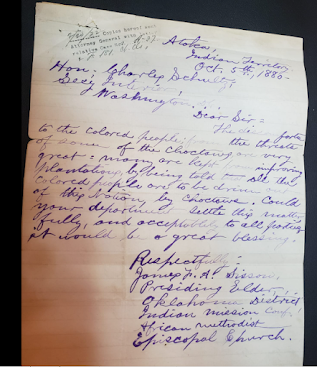
On a recent trip to the National Archives, a letter was found written by Coleman to Rev. James Sisson, a high ranking leader in the AME Church. A follow up letter by Sisson was also found. An image of Coleman's letter appears below, followed by a transcription of the letter.


Letter from Nelson Coleman to AME Elder James Sisson, 1880
National Archives Record Group 75, Entry 604

Transcription of Letter:

Brazil Station, Choctaw Nation

August 29, 1880


Elder Sisson, Dear Friend

    I received your kind and welcome letter yesterday and was glad to get to read a few lines from you, but so sorry to hear that you have been in such bad condition, but I am in hope that you will soon gain your strength back and that we may see each other again face to face. My wife is not in very good health at this time present. All the people is well, I think. I have not heard no complaint.
   I hope that you will tend to that matter for me as soon as possible and send me answer as it concerns me and all of my race of people that live in this territory. We know you to be kind and faithful to us. I hope that you will do the best you can for us. You will please write to me just as soon as you can hear from that matter. So with such few remarks I will close my letter for this time. This leaves us all well. Hoping to hear from you again soon.                                   
                            Yours truly friend

                             Nelson Coleman


Several weeks later, Elder Sisson reache out to the Secretary of the Interior in Washington DC.


Letter from James Sisson to Sec'y of Interior
November 1880
National Archives Record Group 75, Entry 604


Transcription of  Sisson's Letter


                                                                                                              Atoka, 
                                                                                                              Indian Territory
                                                                                                              October 5, 1880


Honorable Charles Schultz
Sec'y Interior
     Washington D.C.

           Dear Sir:

                      The discomforts to the colored people; from the threats of some of the Choctaws are very great: many are kept from improving plantations, of being told that all the colored people are to be driven out of this nation by Choctaws. Could your department settle this matter fully and acceptably to all parties, it would be a great blessing.

                                                                                              Respectfully,
                                                                                              James F. A. Sisson
                                                                                              Presiding Elder
                                                                                              Oklahoma District
                                                                                              Indian Mission Conference
                                                                                              African Methodist
                                                                                              Episcopal Church
 

***** ***** *****

Although both letters are simple letters they reflect the difficult times and issues that Freedmen faced years after slavery was abolished. Some lived with threats and others lived in fear of being driven away from the only place they knew as home.

Sadly, the saga of Freedmen from the Choctaw Nation is one that continues to this day. Both letters above were  written a full five years before citizenship would ever come their way, and the Freedmen at that time were asking questions and seeking their rights then, just as they do today, in the 21st century where today, Freedmen--descendants of Choctaw-held slaves are alienated from the nation of their ancestral nation. No other reason can be except that they come from the enslaved members of the Choctaw nation. And today as descendants of slaves, even those whose ancestors were Choctaws who fathered children, they are kept away, for no other reason than their color, and the slave status of their ancestors.

In the 1980s descendants of the same people, found themselves once again an unwanted people, who had never done anything to merit the alienation demonstrated to them. And now, in the 21st century, and a full year after a letter from the head of the Choctaw nation, Chief Gary Batton, promised to look into the issue of citizenship for them, the gesture has become a hollow one as no one has even had the courtesy of a response to their efforts to reach out to the nation.

Nevertheless, we honor all who worked on the behalf of Freedmen from both Choctaw and Chickasaw nations. Their story continues and their strength is ever enduring. Their story continues to be researched and their stories are being told.

Wednesday, February 2, 2022

Twenty Thousand People Should Not Be Overlooked


Suggested books about Oklahoma Freedmen

* * * * *

As Black History Month has arrived many are honoring those of African descent and the contributions that have been made in the nation. In places like Oklahoma for the first time a workshop discussing Freedmen from Oklahoma will be presented in a workshop presented by the state's historical society. This is applauded and embraced, however so much more has to be done.

In 1906 over twenty thousand people had been classified as Freedmen of the Five Tribes. After a century the number of twenty thousand will more than tripled in number, and clearly over one hundred thousand of descendants today 
can claim ancestry among those thousands from 1906.

Broken down more specifically by nation: 


Indian Freedmen Population in 1906:

Cherokee Freedmen 3982
Choctaw Freedmen 5254
Chickasaw Freedmen 4995
Creek Freedmen 5585
Seminole Freedmen 857 (+ 93 children born later)

Total number of Freedmen from Indian Territory:  20,766


This seldom studied history of the lives of Freed people in Indian Territory deserves attention by Oklahoma-focused historians and also by the state's historical archives. 

Scholars from several disciplines are urged to examine this history and engage with the community of people who descend from the twenty thousand. Their presence has been on the soil of Oklahoma for more than a century. The Freedmen and their parents and grandparents were present in Indian Territory 9 whole decades before statehood. Yet---so little is known about them. 

1) Many arrived in the 1830s as enslaved people. They traveled on the same Trail of Tears spoken about from the Oklahoma Historical Society, to the shores of the Atlantic seabord, yet slavery in the Territory is not taught, nor studied. It is time to change.

2) Once freed, the newly emancipated began their lives in the tribal communities into which they had been immersed, as now a bilingual, bicultural, and in some cases, bi-racial people. Living within two segments of territorical life, the Freedmen emerged as people with a "hybrid" existance, navigating life and facing challenges of frontier and their tribal cultural base.

3) Politics and anti-black racial sentiments, influenced many challenges Freedmen faced, including a racial bias towards them for having African ancestry. The struggles included the effort to become full citizens in the land of their birth and to claim their legacy as citizens of the nations where they had lived as a people enslaved for decades. Some found resistance by the same people who enslaved them, carrying forth racial biases to the present time. Descendants now face a climate where their presence is dismissed on the basis on whether they possess the blood line of the families that enslaved them, as if blood line determine inclusion in a community that perceives to be a "nation" in a country where citizenship is not based on blood line. 

The plight of Oklahoma's Freedmen and their Descendants is a subject that demands truly objective analysis and scholarship. Therefore a call and plea is made to members of the academic community to extend their focus into this overlooked arena. 

Twenty thousand people should not be overlooked! The number of Freedmen from Indian Territory is an impressive number and clearly this is a population that deserves to studied from every academic perspective. Historians have at least made a few efforts to document the history in the past 30 years. But academicians have much work that can be done within their discipline.

Sociologists are needed to study the demographics and the social dynamics of the five groups of people classified as Freedmen. They are needed to study how the Freedmen of these Five Indian Tribes fared and how eventually their status and recognition would change as the decades of the 20th century passed.

Psychologists can pursue issues of identity and self definition by examining the issues and struggle of those who embrace a tribal identity today and who are met with rejection from the tribes to which they have a tie.

Anthropologists have yet to begin to study the cultural norms and language, foodways, traditions, burial practices of Freedmen and how they have changed over time.

Archeaologists have much to explore, with the now disappeared black towns that were built upon tribal reservation land, and also to explore and to find the remnants of the slave dwellings of the large plantations such as that of Robert Jones, the wealthiest Choctaw who had over 500 slavesm and who is known to have been the largest Indian slave holder in the Territory. To date, no studies of former plantations have ever been studied in Oklahoma.

Archives and Arhivists are encouraged to study what records can be found of Freedmen institutions, as they are more than mere memories. 
From Tushka Lusa, to Oak Hill Academy, to Dawes Academy, to the Cherokee Colored High School, to the Tullahassee Manual Labor School--all are gone and the locations of most of these schools are now forgotten. There is much to do from the academic community and hopefully the lives of 20,000 people, all citizens of the Five "Civilized Tribes", will stimulate the interest of scholars from Oklahoma and beyond.

Legal scholars have many avenues to explore, because each tribe had their own relationship with their Freedmen. Some were inclusive and some are continally exclusive and distant, but all deserve study.

Most of the activity involving exploration of Oklahoma Freedmen history revolves around the efforts of a handful of researchers and community preservationists. So much more needs to be done and hopefully more scholars will respond to the call for more study and research.

Monday, January 10, 2022

Bow Fishing Among Choctaw and Chickasaw Freedmen

 One often reads about the culture and life within Indian Territory. However, in reference to the community of Freedmen, very little is mentioned.  A few glimpses of how people lived occassionally appear from rare images captured in the 1890s, some of which reflected the lives of Freedmen in Choctaw country. Many of the images were captured during the Dawes years, when dozens of families gathered to enroll, and photographers were present to capture some of those images.

One image that many are familiar with, is an image of Freedmen who were fishing in one of the many creeks and streams in the Territory.


The image was not a random one, it actually reflected an aspect of how many fished and were able to bring food to their families. Such a fishing method carried on into the 20th century among tribal members.

An interesting article about an elder Nero Perry, a Choctaw Freedman appeared in the Talihina American, in 1906. This elder who was in his mid 70s at the time, still did most of his hunting and fishing with bow and arrow. 

Brought to the Territory during the Chickasaw Removal to the west, Nero Perry lived within the cultural Chickasaw community practicing the lifestyle and culture of the only community that he knew.


Talihina American, 11 Oct 1906 p 2


At the time of the Dawes Commission, Nero Perry lived in the Woodford community, where numerous other Freedmen lived. He was enrolled with his wife Ann, both of whom were in the 60s at the time. 


Ancestry.com. Oklahoma and Indian Territory, U.S., Dawes Census Cards for Five Civilized Tribes, 1898-1914 

[database on-line]. Lehi, UT, USA: Ancestry.com Operations, Inc., 2014.

Original data: Enrollment Cards for the Five Civilized Tribes, 1898-1914; (National Archives Microfilm Publication M1186,
93 rolls); Records of the Bureau of Indian Affairs, Record Group 75; National Archives, Washington, D.C.


Thankfully, though both Nero and wife Ann were elders, and having been brought to the Territory during the Removal, both had a strong memory of their parents and were able to share their names during the years of Dawes Enrollment. Nero's parents were Siah and Lizzie Perry, and the parents of his wife were Sam and Jane Burney. As the article mentioned, Nero had been enslaved by McLish. His wife Ann had been enslaved by Nancy Smith.

It is noted that the parents of each of them had different Chickasaw slaveowners, and were held in bondage by the same person, which reflects how enslaved people were often held by different people and not together as a family, under the same slave holding person. Thankfully their memory of their parents was still with them by the 1890s and their names could be shared, unlike others whose knowledge of loved ones was taken during the years of slavery.  

Hopefully both of them lived to be with their parents after slavery was finally abolished in 1866, and it is hoped that their lives were lives of peace and contentment during their latter years. They remained in the Territory after Freedom, and well into his 70s Nero Perry sustained his life by hunting and bow fishing.

May he be always remembered.


Friday, December 10, 2021

110 Years Ago, Chickasaw Freedmen Lost When Their Lawyer Chose Not to File the Brief


McAlester Weekly Tribune
McAlester, Oklahoma 21 Dec, 1911  p 1.


Bettie Love Ligon, Head Litigant Equity 7071
© Terry Ligon


This week marks the 110th anniversary of the end of Equity Case 7071. The hopes of almost 2000 Freedmen from the Chickasaw Nation were dashed, when the Supreme Court dismissed their case, after their attorney turned against the Freedmen, and suddenly chose not to file the brief, thus preventing their case from being heard in the United States Supreme Court.

Equity 7071 was the case when over 1500 Chickasaw Freedmen who were fathered by Chickasaw men, sought to have their names transferred to the rolls by blood, because they were half Chickasaw by blood. Being transferred to the blood roll did not mean that they were denying that they had African blood. They sought the transfer, because having their Chickasaw blood being recognized, they would have received, 320 acres of land, and not the mere 40 acres that they and nearby Choctaws, chose to give to their former slaves.

While the 40 acre allotment was being given to both Chickasaw and Choctaw Freedmen, those who were counted as persons "by blood"  as well as inter-married whites were given 8 times more land, and had 8 times more of an opportunity to establish generational wealth than those whom they had oppressed, and enslaved, and forced to labor for them, for generations.

The case was challenged when a brave woman called Bettie Ligon, daughter of Robert H. Love, filed suit requesting to be moved from the roll of Freedmen to those by blood, almost 2000 other people joined her in the suit. A lawyer was secured by the Freedmen Webster Ballinger, but suddenly after weeks of working with the Freedmen on a cause that he had convince them was a just cause, he suddently changed his mind, and did not file the brief in front of the United States Supreme Court.

The Freedmen, many of whom had true relationships with their Chickasaw fathers, saw their opportunity to obtain a similar sized portion of land, reduced 8 times, for the only reason being that their mother was a woman with African blood. Their Indian blood did not count, although the white blood of inter-married whites was accepted. These freedmen men, women and children with Chickasaw fathers were being punished for their birth from African women. 

Sadly, the policy exists today, with in both Chickasaw and Choctaw communities saying that "they did right by the Freedmen", giving them 8 time less land, and denying their citizenship today.

Today's policy is based on the decision to not record blood quantum, of Freedmen in the 1890s and to use the rolls that ommitted their blood tie, as the basis for enrollment, thus keeping out black Chickasaw and Choctaw descendants. This allowed both nations to still choose to deny -- or as some see it, to punish people for having ancestors who were held against their will in bondage. Yet many still seek citizenship unaware of this anti-black bias held towards them.

Meanwhile individuals with next to no native blood (as little as 1/1000th blood) are free admitted into both nations today. Those who descend from inter-married whites who were never enslaved, and who had no native blood are welcomed into both tribes today. 

Those whose ancestors toiled for generations, with no payment, to be sold at will of those holding them in bondage, are today prohibited from citizeship.

But for a brief moment, one brave woman led the struggle and filed a suit to be recognized for who she was, Bettie Love Ligon, daughter of her Chickasaw father Robert H. Love. 

May she and all of those once enslaved never be forgotten.

Tuesday, October 19, 2021

New Choctaw & Chickasaw Freedmen Group Makes a Splash on Social Media

 The new organization, Choctaw Chickasaw Freedmen Association has made a splash on Social Media. The new group announced its presence first on Facebook and also with a detailed press release. The new website CCFANow.org came live at the same time and much needed energy has been injected into the community of descendants from both Oklahoma-based federally recognized tribes.

The Facebook page for Choctaw and Chickasaw Freedmen has over 1000 members, and many are now frequenting the new CCFA website for links to pages reflecting their history and their ancestral culture. In addition, a new Instagram page has been created with rich information not only about the new group, but also with useful links to contemporary issues pertaining to Freedmen.


The brainchild of Athena Gaiten Butler, originally of Kansas City Missouri, the group formed a small core group that worked together as a committee to establish, CCFA, the acronym for the group. One of the goals of this new organization is to reach out to Freedmen descendants of both Choctaw and Chickasaw Nations. Although descendants of Freedmen at present do not have citizenship in either nation, descendants of both nations have much in common. Beyond the shared history of their ancestors having once been enlsaved in Indian Territory, their vision extends far beyond a goal of a tribal card.

Some of the goals of CCFA are reflected in their social media presence. CCFA's Instagram account presents history as well as contemporary issues pertaining to both Freedmen communities. Likewise the group also has an accont on Twitter and has had significant Twitter re-tweets to their posts as well.


Much discussion pertaining to CCFA interests stems from much of the activity found on the Facebook page. There are several communities of descendants from both nations, many still living on old land allotments from the past. In addition, many Freedmen descendants also still live within the geographic boundaries of both tribes, while many, especially elders still have a cultural identity to the tribes, despite decades of segregation disenfranchisement and estrangement.

Many Freedman descendants are found on the CCFA Faceboook page, and over 1000 are found on the Descendants group page. Last week on Facebook, in honor of Indigenous Peoples Day, the Descendants group honored the day by honoring their ancestors, and posting images of them and identifying their relationship to their respective nations. Several dozen images were shaared and the reaction to the postings has been extremly positive!

Small Collage of Ancestors Honored on Freedman Facebook Page

On the Facebook Freedman Descendants page, portraits of ancestors were shared, along with the Roll number and Card number. Some who did not have portraits shared images of their ancestor;s Dawes Card. Some elaborated by telling a brief story about their ancestor. Much of this history of various families will be reflected on the website as well as on the pages of social media

Challenges Ahead
Chickasaw Freedmen descendants have  a particularly interesting situation, because the despite the fact that the tribe broke the treaty of 1866, where they promised citizenship for their former slaves, many Freedmen descendants today will still tell others that they are Chickasaw. Likewise, descendants of Choctaw Freedmen also live on land allotments within the geographic jurisdiction of their nation and will tell others that they too, are Choctaw.

Thousands of descendants of both Freedmen groups live "at large" meaning outside of Oklahoma, having had family that migrated north and west. They left seeking more opportunities when the harshness of Oklahoma Jim Crow laws and the appearance of Sundown towns drove them away from the land that was for over a century, their home.

CCFA seeks to educate descendants to their rich history, to interact with those of both nations about the history and culture, and to empower descendants by offering workshops focusing on education, and opportunities for growth. CCFA also hopes to reach out to the community of enrolled Choctaw citizens through cordial meetups, and to encourage social interaction bewteen Freedmen and other fellow Choctaws.

Culturally, many Choctaw Freedmen considers themselves to be among the "Choctaw Proud" or Chickasaw people, and many are unaware that some of their leifestyle, including foodways come from their own their tribal background.

Much of who the freedmen are, will continue to be reflected both on the website and much more is planned to unfold on social media.

Follow CCFA on Facebook, Instagram, and Twitter.