Monday, January 10, 2022

Bow Fishing Among Choctaw and Chickasaw Freedmen

 One often reads about the culture and life within Indian Territory. However, in reference to the community of Freedmen, very little is mentioned.  A few glimpses of how people lived occassionally appear from rare images captured in the 1890s, some of which reflected the lives of Freedmen in Choctaw country. Many of the images were captured during the Dawes years, when dozens of families gathered to enroll, and photographers were present to capture some of those images.

One image that many are familiar with, is an image of Freedmen who were fishing in one of the many creeks and streams in the Territory.


The image was not a random one, it actually reflected an aspect of how many fished and were able to bring food to their families. Such a fishing method carried on into the 20th century among tribal members.

An interesting article about an elder Nero Perry, a Choctaw Freedman appeared in the Talihina American, in 1906. This elder who was in his mid 70s at the time, still did most of his hunting and fishing with bow and arrow. 

Brought to the Territory during the Chickasaw Removal to the west, Nero Perry lived within the cultural Chickasaw community practicing the lifestyle and culture of the only community that he knew.


Talihina American, 11 Oct 1906 p 2


At the time of the Dawes Commission, Nero Perry lived in the Woodford community, where numerous other Freedmen lived. He was enrolled with his wife Ann, both of whom were in the 60s at the time. 


Ancestry.com. Oklahoma and Indian Territory, U.S., Dawes Census Cards for Five Civilized Tribes, 1898-1914 

[database on-line]. Lehi, UT, USA: Ancestry.com Operations, Inc., 2014.

Original data: Enrollment Cards for the Five Civilized Tribes, 1898-1914; (National Archives Microfilm Publication M1186,
93 rolls); Records of the Bureau of Indian Affairs, Record Group 75; National Archives, Washington, D.C.


Thankfully, though both Nero and wife Ann were elders, and having been brought to the Territory during the Removal, both had a strong memory of their parents and were able to share their names during the years of Dawes Enrollment. Nero's parents were Siah and Lizzie Perry, and the parents of his wife were Sam and Jane Burney. As the article mentioned, Nero had been enslaved by McLish. His wife Ann had been enslaved by Nancy Smith.

It is noted that the parents of each of them had different Chickasaw slaveowners, and were held in bondage by the same person, which reflects how enslaved people were often held by different people and not together as a family, under the same slave holding person. Thankfully their memory of their parents was still with them by the 1890s and their names could be shared, unlike others whose knowledge of loved ones was taken during the years of slavery.  

Hopefully both of them lived to be with their parents after slavery was finally abolished in 1866, and it is hoped that their lives were lives of peace and contentment during their latter years. They remained in the Territory after Freedom, and well into his 70s Nero Perry sustained his life by hunting and bow fishing.

May he be always remembered.


Friday, December 10, 2021

110 Years Ago, Chickasaw Freedmen Lost When Their Lawyer Chose Not to File the Brief


McAlester Weekly Tribune
McAlester, Oklahoma 21 Dec, 1911  p 1.


Bettie Love Ligon, Head Litigant Equity 7071
© Terry Ligon


This week marks the 110th anniversary of the end of Equity Case 7071. The hopes of almost 2000 Freedmen from the Chickasaw Nation were dashed, when the Supreme Court dismissed their case, after their attorney turned against the Freedmen, and suddenly chose not to file the brief, thus preventing their case from being heard in the United States Supreme Court.

Equity 7071 was the case when over 1500 Chickasaw Freedmen who were fathered by Chickasaw men, sought to have their names transferred to the rolls by blood, because they were half Chickasaw by blood. Being transferred to the blood roll did not mean that they were denying that they had African blood. They sought the transfer, because having their Chickasaw blood being recognized, they would have received, 320 acres of land, and not the mere 40 acres that they and nearby Choctaws, chose to give to their former slaves.

While the 40 acre allotment was being given to both Chickasaw and Choctaw Freedmen, those who were counted as persons "by blood"  as well as inter-married whites were given 8 times more land, and had 8 times more of an opportunity to establish generational wealth than those whom they had oppressed, and enslaved, and forced to labor for them, for generations.

The case was challenged when a brave woman called Bettie Ligon, daughter of Robert H. Love, filed suit requesting to be moved from the roll of Freedmen to those by blood, almost 2000 other people joined her in the suit. A lawyer was secured by the Freedmen Webster Ballinger, but suddenly after weeks of working with the Freedmen on a cause that he had convince them was a just cause, he suddently changed his mind, and did not file the brief in front of the United States Supreme Court.

The Freedmen, many of whom had true relationships with their Chickasaw fathers, saw their opportunity to obtain a similar sized portion of land, reduced 8 times, for the only reason being that their mother was a woman with African blood. Their Indian blood did not count, although the white blood of inter-married whites was accepted. These freedmen men, women and children with Chickasaw fathers were being punished for their birth from African women. 

Sadly, the policy exists today, with in both Chickasaw and Choctaw communities saying that "they did right by the Freedmen", giving them 8 time less land, and denying their citizenship today.

Today's policy is based on the decision to not record blood quantum, of Freedmen in the 1890s and to use the rolls that ommitted their blood tie, as the basis for enrollment, thus keeping out black Chickasaw and Choctaw descendants. This allowed both nations to still choose to deny -- or as some see it, to punish people for having ancestors who were held against their will in bondage. Yet many still seek citizenship unaware of this anti-black bias held towards them.

Meanwhile individuals with next to no native blood (as little as 1/1000th blood) are free admitted into both nations today. Those who descend from inter-married whites who were never enslaved, and who had no native blood are welcomed into both tribes today. 

Those whose ancestors toiled for generations, with no payment, to be sold at will of those holding them in bondage, are today prohibited from citizeship.

But for a brief moment, one brave woman led the struggle and filed a suit to be recognized for who she was, Bettie Love Ligon, daughter of her Chickasaw father Robert H. Love. 

May she and all of those once enslaved never be forgotten.

Tuesday, October 19, 2021

New Choctaw & Chickasaw Freedmen Group Makes a Splash on Social Media

 The new organization, Choctaw Chickasaw Freedmen Association has made a splash on Social Media. The new group announced its presence first on Facebook and also with a detailed press release. The new website CCFANow.org came live at the same time and much needed energy has been injected into the community of descendants from both Oklahoma-based federally recognized tribes.

The Facebook page for Choctaw and Chickasaw Freedmen has over 1000 members, and many are now frequenting the new CCFA website for links to pages reflecting their history and their ancestral culture. In addition, a new Instagram page has been created with rich information not only about the new group, but also with useful links to contemporary issues pertaining to Freedmen.


The brainchild of Athena Gaiten Butler, originally of Kansas City Missouri, the group formed a small core group that worked together as a committee to establish, CCFA, the acronym for the group. One of the goals of this new organization is to reach out to Freedmen descendants of both Choctaw and Chickasaw Nations. Although descendants of Freedmen at present do not have citizenship in either nation, descendants of both nations have much in common. Beyond the shared history of their ancestors having once been enlsaved in Indian Territory, their vision extends far beyond a goal of a tribal card.

Some of the goals of CCFA are reflected in their social media presence. CCFA's Instagram account presents history as well as contemporary issues pertaining to both Freedmen communities. Likewise the group also has an accont on Twitter and has had significant Twitter re-tweets to their posts as well.


Much discussion pertaining to CCFA interests stems from much of the activity found on the Facebook page. There are several communities of descendants from both nations, many still living on old land allotments from the past. In addition, many Freedmen descendants also still live within the geographic boundaries of both tribes, while many, especially elders still have a cultural identity to the tribes, despite decades of segregation disenfranchisement and estrangement.

Many Freedman descendants are found on the CCFA Faceboook page, and over 1000 are found on the Descendants group page. Last week on Facebook, in honor of Indigenous Peoples Day, the Descendants group honored the day by honoring their ancestors, and posting images of them and identifying their relationship to their respective nations. Several dozen images were shaared and the reaction to the postings has been extremly positive!

Small Collage of Ancestors Honored on Freedman Facebook Page

On the Facebook Freedman Descendants page, portraits of ancestors were shared, along with the Roll number and Card number. Some who did not have portraits shared images of their ancestor;s Dawes Card. Some elaborated by telling a brief story about their ancestor. Much of this history of various families will be reflected on the website as well as on the pages of social media

Challenges Ahead
Chickasaw Freedmen descendants have  a particularly interesting situation, because the despite the fact that the tribe broke the treaty of 1866, where they promised citizenship for their former slaves, many Freedmen descendants today will still tell others that they are Chickasaw. Likewise, descendants of Choctaw Freedmen also live on land allotments within the geographic jurisdiction of their nation and will tell others that they too, are Choctaw.

Thousands of descendants of both Freedmen groups live "at large" meaning outside of Oklahoma, having had family that migrated north and west. They left seeking more opportunities when the harshness of Oklahoma Jim Crow laws and the appearance of Sundown towns drove them away from the land that was for over a century, their home.

CCFA seeks to educate descendants to their rich history, to interact with those of both nations about the history and culture, and to empower descendants by offering workshops focusing on education, and opportunities for growth. CCFA also hopes to reach out to the community of enrolled Choctaw citizens through cordial meetups, and to encourage social interaction bewteen Freedmen and other fellow Choctaws.

Culturally, many Choctaw Freedmen considers themselves to be among the "Choctaw Proud" or Chickasaw people, and many are unaware that some of their leifestyle, including foodways come from their own their tribal background.

Much of who the freedmen are, will continue to be reflected both on the website and much more is planned to unfold on social media.

Follow CCFA on Facebook, Instagram, and Twitter.


Thursday, October 14, 2021

Rare Census Record Reveals Early Roots of Choctaw Freedman Family

 A rare 1890 census document is found in a collection of records from the Choctaw Nation. On that record is found the name of the Hall family, of Choctaw Freedmen. Thomas Hall, his wife Rachel, and his sister Charity are on the document. What distinguishes the record is that the applicants are elders, all over 70 years of age, placing their years of birth in the 1820s! Their ages indicate that they were born several years before Choctaw Removal in the early 1830s. 

The Family of Thomas Hall, Choctaw Freedmen 
Typically, when researching records of the Freedmen of Indian Territory, the enrollment cards which are part of the Dawes records, are studied. In this case, the family of Thomas, Rachel, and Charity Hall, are found on Enrollment Card #435.

The National Archives at Fort Worth; Fort Worth, Texas; Enrollment Cards, 1898-1914; NAI Number: 251747; Record Group Title: Records of the Bureau of Indian Affairs; Record Group Number: 75  (Choctaw Freedman Card #435)

On the reverse side of the card the names of Thomas and sister Charity's parents are revealed: 

Source: Same as above. Image shown is reverse side of card.

Sam and Nancy Hall are their parents. In many cases with elders who were Choctaw Freedmen, the names of parents are not always recorded, but in this case they were. Rachel, Thomas' wife also identified her own parents, who were Ben Seward and Phillis Seward. It is stated that they were actually somewhere in Texas. But the interview from the Application Jacket reveals that most of their entire life was spent in Indian Territory.


Applications for Enrollment of the Commission to the Five Civilized Tribes, 1898–1914. Microfilm M1301, 468 rolls. NAI: 617283. Records of the Bureau of Indian Affairs, Record Group 75. The National Archives at Washington, D.C. (Image accessed on Ancestry)


Additional Records Reveal Much More

The first extensive Federal census in Indian Territory was taken in 1900 so the Dawes records are  critical to examininig Freedmen history before that time. However, a rare record from 1890 was shared in an online Facebook group known as The Choctaw-Chickasaw Freedmen Descendants group.(Special thanks, Sandra Riley.)

The document was part of a collection of records from the Oklahoma Historical Society. They are now digitized and found on Ancestry as part of earlier pre-statehood records from the Choctaw Nation known as CTN records. (CTN means Chotaw Nation)

On the microfilm reel  CTN 4, also found on Ancestry, there are many records from the old districts in the Choctaw Nation.  There are 468 images on the reel. On image #318 some records from Towson in the Choctaw Nation are reflected and two of the pages reflect Freedmen. On that record are the Halls.


Source: Indian Marriage and Other Records, 1850–1920. Oklahoma Historical Society, Oklahoma City, Oklahoma. Image acessed from Ancestry  CTN 4 Image #316 of 468. 1890 Census of Towson Choctaw Nation


It should be pointed out that most of the 1890 census was destroyed by fire in 1923. However, this unique census record was not part of the records housed in the U. S. Commerce building, when the fire struck the records. Thankfully this rare set of pages were not affected as they were not in the Commerce building at the time.

Interesting Data About the Thomas Family

That 1890 census record reflects some interesting details about this family. Thomas and his sister Charity were born in Mississippi. His wife Rachel however, was born in Virginia!  And both of her parents were also born in Virginia. Virginia ancestry is rare for a Choctaw Freedman.  On her enrollment card (shown in first image above), it says that her parents Ben and Phillis Seward were located or had been situated in Texas--to the south of Indian Territory.  So clearly in her early years she and her parents were either sold or removed with others from Virginia, to Texas, but clearly Rachel somehow ended up enslaved in the Choctaw Nation. 

In addition to Rachel being born in Virginia, she could also read. This reflection of her literacy as well as place of birth for her and her parents makes this rare image even more interesting! But how Rachel came to be in Indian Territory will not be known, but it is clear that she was in the Choctaw Nation quite early, because she and her husband were enslaved by the same Choctaw man, Eastman Loman. 

Did Loman go to Texas to purchase slaves or to purchase a female for Thomas?  Or was Rachel removed from her parents when taken to the territory? Was contact ever made with them after freedom?  The answers are not known and will perhaps never be, however, the record does exist to point to an early American presence of this family in post colonial Virginia. Many untold stories remain to be told, especially how many Choctaws obtained their human chattel slaves. 

It is revealed on the record, that sister Charity was never married, and remained close to her brother and family into their later  years. Seeing a rare household only of only elders living together makes this find even more special. Thankfully they all lived to receive allotments of land, and it is hoped that there were generations that followed them and that lived to tell their story.

Thursday, September 30, 2021

Choctaw and Chickasaw Freedmen Announce New Organization


After much planning and organization, a group of descendants of Choctaw and Chickasaw Freedmen have gotten together and decided to work to share some of their common interests in goals under an organziational umbrella called the Choctaw-Chickasaw Freedmen Association.

The name is derived from the old group from the late 1800s when Freedmen newly released from bondage sought strenght and guidance from each other. 

In the past 4 months much activity pertaining to the plight of Oklahoma Freedmen, since Chief Garry Batton released his Open Letter on his blog. In that letter he stated that he plans to start dialogue about the possibility of offering citizenship to Freedmen descendants.

In June many groups began writing to the Choctaw Nation expressing their interest in the subject. Most have never receive any kind of acknolegment that their letters were receive,  however, many began to organize and see where their talents could be utilized to work towards a greater awareness of history and to offer assistance to those who may have an interest in the current dialogue.

At the suggestion of a descendant from Kansas City, now living on the East Coast, Ms. Athena Butler pulled together a group of people to work with her, and after many weeks of discussion the group has worked to create the new organization, known as the Choctaw Chickasaw Freedmen Association.

Focus of the Group:
"CCFA is an association of advocacy and training that will develop and identify resources to those who are interested in gaining more knowledge about their Oklahoma-based Freedmen Ancestors.

Major focus will be on the contributions of Freedmen (including their ancestors), & the roles they played within the Choctaw and Chickasaw Nations.

In addition, CCFA will explore the reasons for the omission of Freedmen history and the group will work to put this history properly on the pages of tribal history." Vision of the Group:

CCFA will educate through webinars, videos and publications.

CCFA will empower through workshops, and question and answer sessions

CCFA will engage members through regular online meetings.

CCFA will embrace the culture and history by studying, language, culture and history of the community from which they come.

The Founders of the group are: Athena Butler, Terry J. Ligon, Jerry H. Moore, Angela Walton-Raji, and Sandy Williams. One of the first activities of the group will be to offer a basic genealogy workshop on October 6th. Many additional workshops are being planned for upcoming months, into the new year. Hopefully this new group will change the trajectory for descendants of both Choctaw and Chickasaw Freedmen. With more information, a stronger people will emerge. With organization, more options will open. With determination, the members will become empowered.


Thursday, July 22, 2021

Fort Coffee, A Fort, A School, & A Freedman Town

 An interesting article written in 1949 provides a fascinating overview of one of Oklahoma's Black Towns. Fort Coffee that began at the top of a bluff in a horseshoe bend in the Arkansas River has a fascinating history.

The area was once referred to as Swallow's Rock, or as it was called by the original name in French, "Roche des Hirondelles", and by some simply as "Hirondelle". On very old maps the name "Hirondelle" is found.


 Swallow Rock

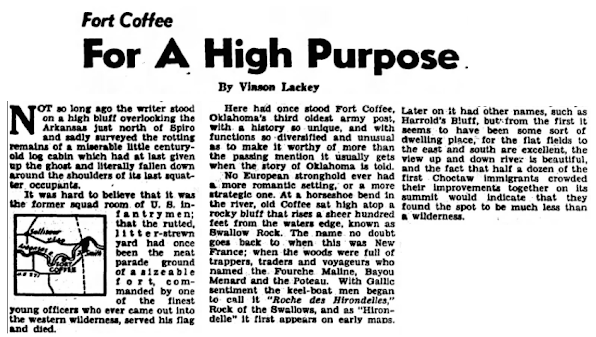
However, the occupation of the area began as military fort. Viason Lackey, a writer for the Daily Oklahoman wrote a fascinating article about historic forts, and on March 13th 1949, he covered the early history of Fort Coffee.


The Daily Oklahoman, 13 March, 1949 page 69
(image cropped for space)


The article which is quite lengthy goes in to much detail about how Choctaw moved into the area early one, followed by white settlers. The issue of alcohol was a major one at the time, and a law was passed prohibiting the establishment of any kind of distillery in the area.


During this time, the larger party of Choctaws had begun to arrive in the same area. The Treaty of Dancing Rabbit Creek was signed and Choctaw emigration to the west had begun. With the arrival of Choctaws into the area, the issue arose again of alcohol, and military was then brought into the area to serve as an enforcement of the prohibition of alcohol.


As the monitoring of alcohol began to wane, troops were sent to the barracks in Fort Smith. Shorty afterwards a major flood occurred on the Arkansas River in 1834. This was one of the largest floods seen since the establishment of Fort Smith. Because of the prevalence of high water, an infestation of mosquitos and the aftermath a new fort on higher ground was constructed.


With the new fort now on higher ground, the ensuing task was the patrol the river, inspecting numerous boats navigating the waster, in search of illegal alcohol. 

After the Fort was abandoned, the site eventually was turned over the Choctaws, who had begun to occupy that area heavily, as a result of the Indian Removal. The Choctaws then established a boys academy. This school was the "brother" school to a girl's academy that had been established in New Hope.


An artist's sketch of Fort Coffee Academy
Oklahoma Historical Society


Interestingly, the article made a reference to the anti-slavery stance that many of the missionaries at the school had taken. Many did not support the practice of slavery by some of the Choctaws, and they shortly left and returned to the north. The "southern branch" of the Methodist Church then ran the school till the end of the war.

Some of the buildings of the old fort became buildings to establish the Choctaw Boy's Academy. One image of one of the buildings was captured in the early 1900s. But not much is known in detail about the layout. What is significant however, was that there was an enslaved woman who was under the "ownership" of the Academy.

The Lone Slave of Fort Coffee Academy
In February of 2019 an article was written about an unknown woman who was enslaved and who worked the grounds of the Fort Coffee Academy. Reference to her existence is found on the 1860 slave schedule a census enumeration of the people held in bondage. The official "owner" of record, was Fort Coffee Academy.


She was on the only enslaved person listed as being "owned" by the school. Was she the reason that the faculty left the school?  As was asked in the earlier article, did she live alone?  Was she near others? Was there possibly another community of enslaved people living nearby?

"It can only assumed that she was cook, cleaner, and tended to numerous tasks that required physical labor at the school. Was she treated kindly? Did she endure sexual harassment in the all male environment of the school? Was she required to also live on the premises? Did she have a room or her own? Did she sleep in a separate cabin?

And, would the privacy of a lone female slave even have been considered? Did she sleep on the floor, near the fireplace? Did she have children and family of her own for whom she pined? If she had children, could she visit them? Or would she have had to wait until freedom came to connect with her own family? And importantly, did she live to see freedom and to breathe free air?

Most of the answers to the questions will never be known. Clearly, s
he was the only person enslaved by the Academy, and a note underneath indicates that she was under the "care" of Rev. Dr. Paine.  One fact is evident, however. Shew as the only person who was a "slave of Fort Coffee Academy."  The document reflecting the enslaved people, has a column where the number of slave dwellings existed on the premises. With her, clearly there is no slave dwelling in which she resided. Did she possibly reside in the home of the Rev. Dr. Paine?

A closer look at the 1860 Population census, in the Choctaw Nation, a Methodist minister named, Frances Paine, is found living in Skullyville. This was the same area location of Fort Coffee. He resided there with a fairly large family.

Chances are that this enslaved woman may have been a "servant" to the family of Rev Paine, in addition to her performing other duties for the academy. And since there were no slave dwellings on the premises, she most likely slept in a small space in the Paine home.


 One other clue about Rev Paine being the same man mentioned as part of the Choctaw Academy, some of the neighbors in the population census are identical to the slave holders on the slave document. In addition others who were enumerated in the same population census page corresponded to the same names of some of the slave holders on the slave census schedule.  

The story of what may have happened to this enslaved woman at the Fort Coffee Academy and her life after freedom is not known, but hopefully her story and other stories will begin to surface as research about the Fort Coffee and other nearby settlements will unfold. 

During the Civil War, most of the buildings were destroyed, and today the old fort site is on private property. 


One site in this old Skullyville area was the Hall Plantation. In 1861 there was a slave uprising that occurred on the plantation. The men in the Hall family were killed by some who participated in the events. However, whatever had precipitated the uprising is not known. The Civil War began around the same time. Jacob Hall one of the enslaved men from the Hall estate, enlisted in the US Colored Troops. The settlements of enslaved people near the Fort Coffee area, witnessed many black Union soldiers coming in from Fort Smith. The 79th and 83rd US Colored Infantries, and the 11th US Colored Infantry was organized in nearby Fort Smith. The Civil War soldier Jacob Hall was a private in the 79th US Colored regiment. He was also the father to Squire Hall, who served as a local deputy in the Skullyville Fort Coffee area.

After the Civil War, many remained exactly where they had always lived, and when the Choctaws signed the treaty of 1866 the enslaved people, finally found freedom. Many who had lived in the Skullyville Oak Lodge, and Braden, and Brazil communities remained in the area. Many eventually lived within a few miles of the old fort, turned academy. Though the school fell into neglect and disrepair, the Freedmen families remained intact. 
Families from the local area became Choctaw citizens after they were given citizenship in 1885. In addition, some families of Chickasaw Freedmen moved into the same area, having to leave hostile and sometimes violent conditions in the Chickasaw Nation. Many married into Choctaw Freedmen families and today some residents of Fort Coffee descend from both Choctaw and Chickasaw citizens.

Before Oklahoma statehood, several neighborhood schools were established by the Choctaw Nation. One of the schools was the Fort Coffee Neighborhood school. A school roster from the old Fort Coffee school was found about 10 years ago. On that roster were children from the Butler, Craig, Colbert, Clayton, Eubanks, Nail, Springs, and Walton families. Two staff members of the school were S. H. Hall, and Moses Parker. Other neighborhood schools were also established in the Skullyville District of the Choctaw Nation.


One of the student rosters from Fort Coffee Freedman School


Today Fort Coffee still exists, but now, as a town with several hundred residents. The Encyclopedia of Oklahoma refers to Fort Coffee, and notes that the old Fort sits on private property. The old ridge known as Swallow Rock no longer exists. Much of the old rock was quarried by the US Corps of Engineers, that was later used to construct the Kerr Lock and Dam. 

But today the town of Fort Coffee is home to numerous families that descend from Choctaw and Chickasaw Freedmen who lived in the area. It is one of the few remaining Oklahoma Black Towns, with a rich cultural tradition and proud people who descend from the community.

* * *

Thursday, May 27, 2021

Chief Gary Batton to Launch Initiative to Discuss Citizenship for Choctaw Freedmen

 "Today we reach out to the Choctaw Freedmen. We see you. We hear you. We look forward to meaningful conversation regarding our shared past."`
                                -Gary Batton, Chief of the Choctaw Nation-May 27, 2021

* * * * *


Chief Gary Batton has released an "Open Letter" on the Chief's Blog on the Choctaw Nation website. It was announced in his letter that the tribe is announcing an initiative to consider tribal membership for Choctaw Freedmen.

It was pointed out in the letter that "this initiative will engage Choctaw Freedmen, the Department of Interior, existing tribal members, our elected officials and membership department officials, and other Choctaw proud in listening sessions to present findings and a recommendation to Choctaw elected officials."

This open letter appears to be quite different from the letter sent to Speaker Pelosi earlier in the year.  This letter also suggests that there is an interest in including Freedmen in the discussions, which had prior to this time never occurred.

The issue of Choctaw Freedmen has had much discussion over the years, in public and private venues, and in recent months, on numerous social media platforms. Choctaw Freedmen like Freedmen of the other tribes, have a history that extends back prior to statehood, the allotment process, westward expansion, reconstruction era, Civil War, and also prior to Removal.  The political history and cultural history of Choctaw Freedmen, comes from a shared history, where people of African descent arrived at the same time as other Choctaws, in the land that later became Oklahoma.

Freedmen from the Choctaw Nation were a bi-cultural, bilingual people, and in some families, bi-racial people immersed into a Choctaw world. They emerged as a people who lived, worked and died as a Choctaw people.

This announcement from Chief Batton, comes at a time, when the eyes of the world are looking at Oklahoma. The 100th Anniversary of the Tulsa Massacre has brought many people to Oklahoma. The national and the inter-national press is now in Oklahoma to cover the events. But in addition to the Tulsa story, some of the journalists are asking questions about Oklahoma's black history, including that of the  Oklahoma Freedmen. There are, as a result, looking at the former slave-holding tribes closely.

The news of the open letter coming out just prior to the weekend events in Tulsa is timely, and it provides an opportunity for the Choctaw Nation to embrace all of its past, and all of the people that are part of that history.

Choctaw Freedmen were those people, once enslaved in the Choctaw Nation.
Choctaw Freedmen were never enemies of the Choctaw Nation.
Choctaw Freedmen freed by treaty, remained there and lived faithfully on Choctaw soil, as Choctaw people.
Choctaw Freedmen were among the thousands who saw themselves as a Choctaws and today they now have thousands of descendants who consider themselves today to be among the "Choctaw proud."

The words of Chief Batton are welcomed words. Freedmen descendants now look and await the opportunity to engage with, listen to, and hopefully to learn from
each other. We are far more alike than not. And after over 100 years, the time has come to engage, again.