Monday, June 2, 2014

Choctaw Freedmen: Dunford Family Legacy from the Choctaw Nation Back to Africa

Zach Dunford, Enrollment Card
NARA Publication M1186 Choctaw Freedmen 909

Zach Dunford lived in Jackson County in the southern part of the Choctaw Nation. He was the son of Dock Dunford and both had at one time been enslaved by the wealthy Robert Jones.


Choctaw Nation Map

This is an interesting family case for two reasons. The Dunfords had been enslaved by Robert Jones, who was one of the largest slave holders in the Choctaw Nation, and possibly the wealthiest slave holder in Indian Territory. At one time, Jones was said to have held over 200 people enslaved. (1)


In 1899 Zach appeared in front of the Dawes Commission to apply for enrollment for himself, his daughters and grandchildren. His wife Catherine was deceased at the time of his application.

Close up view of larger enrollment card


The Dunfords lived in Jackson County and the township of Jackson as well. The enrollment card for the family is a good example of how data can lead to more information about the family. It is noted that Zach Dunford's wife and the mother of the children is not listed on the card, however, the reverse side of the card points out that she was deceased. But interestingly, it appears that Zach Dunford's parents were still living. This is known because the usual notation of "Dd" meaning "deceased" does not appear on the card, suggesting that his parents may have still been living.

Reverse side of Choctaw Freedman Enrollment Card 909

On the front of the card, addition information is provided which leads the attentive researcher to even more data about the family and it clearly points to additional documents.

(Notes on card point out that the grandchildren were enrolled later. Also there is a reference to a marriage record that was submitted to the Dawes Commission.)

I decided to examine the Application Jacket that corresponds to this family file to see if I could find information regarding the Zach Dunford's marriage, since his wife was now deceased. What was contained in the file was a hand written document that revealed the sworn testimony of Zach's mother Charity Dunford who was at that time in her 80s.  And within that statement she spoke to the marriage of Zach to his wife Catherine and she stated that she was a witness to the marriage.

Statement of Charity Dunford, mother of Zach Dunford
National Archives Publication M1301 Choctaw Freedman file 909

Unexpected Surprises

While reading Charity Dunford's statements, two things stood out in my mind. First of all here was an 80 year old woman giving testimony for her son. This 80 year old woman was one of the oldest living Choctaw Freedmen to have been interviewed by the Dawes Commission. Being approximately 80 years old, this meant that she was born approximately in the 1820s and was living several years before the Removal of Choctaws to the West. Was she born in Mississippi, or had she been brought to Mississippi, and then later purchase by Choctaws and taken west?

The second surprise which was caught me by surprise was reading the statement where Charity Dunford describes her son's marriage to wife Catherine. The marriage was performed by Sam Walters. That was my great grandfather, Samuel Walters. The family surname eventually evolved into Walton, but while he was a traveling preacher and active Minister of the Gospel, he used the name Walters.

Marriage Performed by Sam Walters, (my gr. grandfather)


Jack Dunford's Siblings

Enclosed in the same file was a statement by Eliza Garrett. She identified herself as Zach Dunford's sister, and she too witnessed their marriage performed by Sam Walters.


In many cases, one document leads to another, and with these two statements are the possibilities that were files on Eliza Garrett and her family, and a file for the mother Charity.

Since Charity was still living at the time of the Dawes process, the next question was could Charity Dunford's enrollment file be found? Considering her age at the time this would truly open doors for the Dunford family research.

I decided to check the database and was quite pleased to discover that both of Zach's parents were indeed Dawes enrollees, and they were listed on Choctaw Freedman card, 814.

Zack Dunford's parents Dock and Charity were enrolled on Choc. Fr. card 814


The Oldest Freedman Enrollee?

Upon closer examination it is amazing to see that Dock Dunford was said to have been over 100 years old. 

When they applied it was 1899 and he lived to be placed on the final roll, thus making him possibly the oldest former slave to have survived through the Dawes process!

It is clearly understood that ages are often a mere estimate especially when one is researching people once enslaved, so even with a margin or error of 5 or more years, clearly Dock Dunford was extremely old at the time.

I decided to see if he could be found on the Federal census, since there was a Federal census conducted in the Choctaw Nation in 1900.

From Africa to Indian Territory

Sure enough, in the 1900 census Dock Dunford, and Charity, parents to Zack and Eliza, were enumerated in 1900. Their birthplace was said to have been in the Carolinas--Dock, in South Carolina, and Charity in North Carolina. But what a surprise to also see that Dock's mother was said to have been born in Africa!

Source Citation: Year: 1900; Census Place: Township 7, Choctaw Nation, Indian Territory; Roll: 1852; Enumeration District: 0116; FHL microfilm: 1241852.

This is the first time I have found a person enumerated in Indian Territory with an African born parent. His mother's birthplace was listed as Africa. In the case of Dock Dunford, he was truly one generation away from Africa.

The back side of his enrollment card revealed the name of his mother, Mollie Patterson. 
Reverse side of Choctaw Freedman Card 814

So many things come to mind while looking at her name on the card. If she was born in Africa, then it is clear that her name was not Mollie---and that she would have had an African name when she arrived in this land. But the cruelties of slavery stripped her birth name, and she had to die in a foreign land with a name of Mollie, and the name of the person who claimed her as his property, Joshua Patterson. 

One can only imagine the heartache in her own life, as a survivor of the Middle Passage, and the loss of everything familiar to her. Mollie is known to be a nickname for Mary, and for this dear African woman I can only pray that her entire life was not pain filled. A simple prayer for her, comes to mind, "Oh Mary, don't you weep".

But finding an African ancestor of this Dunford family line warms my heart if not for this one reason: At least the memory of Mollie was retained when the 100+ year old Dock could call her name, and state the land of her birth, somewhere on the African continent.  

There is so much more to the legacy of the Dunford family. It is a one with strong roots and a strong legacy. Hopefully the Dunford family and Garretts, Harris and others connected to this southern Oklahoma line, are still celebrating their rich Oklahoma History where they lived to see freedom, their rich Choctaw Nation legacy where for several decades of their family history was tied, their passage through South Carolina, and their strong African legacy as well. 

The sons and daughters of this Oklahoma family have a worthy story to tell, and it is one that if pursued even further, will lead to fascinating places in their family history.


* * * * * * * * * * *
1.  Encyclopedia of Oklahoma History and Culture, Oklahoma Historical Society Link: SOURCE

Sunday, May 4, 2014

Choctaw Freedman Genealogy: The Case of David Gardner

National Archives Publication #M1186
Choctaw Freedman #843, David Gardner, Bokchito, Choctaw I.T. 

 Rich family data can be found in the Gardner family of Bokchito, Indian Territory. The large clan of Gardners lived there among other Choctaw Freedmen in the town of Bokchito, in Indian Territory. The patriarch of this large clan was 56 years old at the time he appeared at the Dawes Commission to enroll himself and his family including his wife, seven children and four grandchildren.

David Gardner's mother Silva had been enslaved by Choctaw Sally Gardner, and his father who was Jim Harris was enslaved by Green Harris. It is not known why he did not carry the surname of his father, and used that of his mother's most of his life. It appears that Wm. Gardner, listed as the slave holders was possibly not a Choctaw citizens, but his wife Sally was the Choctaw citizen. And the same Sally Gardner was noted as the slave holder of record for David's mother Silva.


National Archives Publication #M1186   Choctaw Freedman # 843
The reverse side of the Enrollment Card for David Gardner, reflects the name of the parents of each applicant, whose names appears  on the front side of the Dawes Enrollment  card, including the young children.


Because there are so many notations on the card, the information pertaining to the grandchildren appear on the front side, including their dates of birth. But they are on opposite ends of the card so that critical information is not immediately visible to the eye. The overlay and the arrow illustrate this data pertaining to the grandchildren.

Enrollment Card highlighting data on grandchildren


Following up on the Application jacket (NARA Publication #M1301) the corresponding file for David Gardner contains no interview. The memos generally pertain to the enrollment of the grandchildren and how they were considered eligible for enrollment. The focus seemed to be placed on the children of Abner and his wife Clara and whether or not their children were eligible for enrollment or not.


Additional notations on the card suggest that there are additional records to explore. One such statement refers to a card where the children of Abner were being considered for enrollment. 

This notation from the front of David Gardner's card, makes a reference to Choctaw Freedman Card #D82.


The enrollment card initially put on D82 (meaning Doubtful Card #82) also had data on the same family. The information on this card can lead the researcher directly to the mother Clara's enrollment card with her family. The card was created before her marriage to Abner Gardner.

National Archives Publication #M1186 Choctaw Freedmen D82

Reverse side of same card above.


That particular file (Choctaw Freedmen D82) does contain additional information about the family. Included in that file was some very interesting history pertaining to Clara, Abner's wife and her own family's status as having been enslaved by Choctaw Indians.

National Archives Publication M1301 Application Jackets, Choctaw Freedmen D82

Page 2 of interview from same file.


Page 3 from same file.

There is much more to the family history and it is known that in many cases one file leads to another, and one document can always point to more. Within one family the wife's family is also a part of that history, and often by following the clues left in the primary file, one can open the doors to much data.

This is the case in the family of David Gardner of Bokchito, a family of Choctaw Freedmen.


Sunday, April 27, 2014

Choctaw Family Research - The Case of Hepsy Williams


National Archives Publication Number M1186
Choctaw Freedman Card #56

While researching Dawes Commission records, I was looking at random cards and was appreciating how much data can be gleaned from one card. The case of Hepsey Williams was a good example.

Hepsey Williams appeared in front of the Dawes Commission on September 16, 1898. At the time she and her family lived in Chickasaw country as many Choctaws did, and they resided in the community of Hennepin. Today that area is a small community in southern Garvin County Oklahoma.

On her card it is also noted that she was born enslaved and was once enslaved by Sam Colbert. On the reverse side one learns the names of Hepsy's parents--Voyage and Edie James. Her parents had different slave holders. Molsey Colbert was Voyage James' slave holder and Sam Colbert had enslaved her mother Edie. And information about the father of Hepsy's children also appears on the same side of the card.

Reverse side of enrollment card for Hepsy Williams
(Choctaw Freedman Card #56)

Notice that Hepsy's father Voyage James was deceased at the time Hepsy appeared in front of the commission, however, her mother Edie was still alive. So a card can be found with Edie's name upon it.

National Archives Publication #1186
Edie James Choctaw Freedman Card #51

Edie was an elderly lady of 70 who appeared for herself and a small grandson, Rennie Oliver. She had been a slave of Choctaw Sam Colbert. Hepsy did not mention her father, but noted that her mother's name was Dilsey. Most likely her mother Dilsey was born in Mississippi, before removal. This is one of the cases in which the names of slaves of Choctaws (and other tribes) who were enslaved before removal appear.

The community is usually noted on the front of the card in the upper left hand corner of the Dawes Enrollment Cards, and Hepsy's card was no exception. Their residence in the Chickasaw Nation was indicated, and their closest post office was the town of Hennepin.


 She is married to John Williams who is not a citizen of the Choctaw Nation. She was applying only for herself and her children.

Names found upon enrollment card of Hepsy Williams, Choctaw Freedwoman.

On her Dawes Card, some extremely useful data appears at the bottom of the card. These notes are usually additional information added after the applicant's first appearance in 1898, but still before the rolls closed. One can also tell because each time additional information was provided, there was a difference in the penmanship. In addition, the data pertained to two of Hepsy's children, her son Joe and her daughter Gertie.

Notation at bottom of enrollment card for Hepsy Williams

The first notation pertains to a child that Joe had after he had married. That child was enrolled as a Chickasaw Freedmen and is on Chickasaw Freedman card number 159. The second note was that of a child later born to Gertie after her marriage, and that data could be found on Choctaw Freedman card number 149.

National Archives Publication Number M1186
Chickasaw Freedman Card #159

On this first card it it noted that the child's name was Mabelle Farris, and the parents were Joe Farris, (Hepsy's son) and Annie Farris who was by that time, which was 1906, Joe's wife. 

It also cannot go unnoticed that the child was being enrolled as a Chickasaw Freedman and not Choctaw. That is because the Annie the mother was herself a Chickasaw Freedman. Also it can be seen that at first the application was denied and the card was stamped "Refused" but two months later it was approved and Mabelle was eventually added to the rolls as a Minor Chickasaw Freedman.

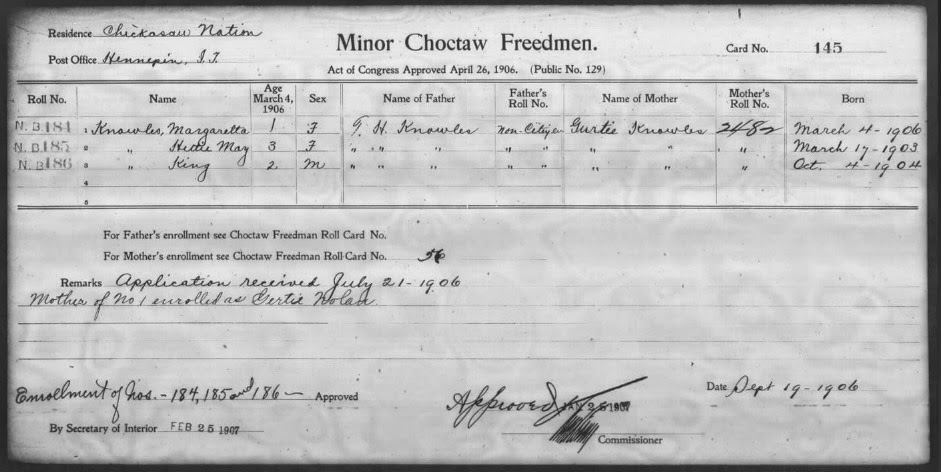
The second critical notation was that Gertie had married after that initial application in 1898, and she was now the wife of Thomas Nolan. She had a child who was later enrolled as a Choctaw Freedman on the Freedman New Born cards. 

National Archives Publication #M1186
Choctaw Freedman New Born #145

 It is immediately noticed that the children as well as Gertie herself carried the last name Knowles and not Nolan as indicated on the enrollment card for Hepsy and her children. But the name Nolan is cross referenced on the card and there is no indication that there were two different people.

Interestingly there was no interview under oath in the file, however, a marriage certificate reflecting Gertie's marriage was filed in the record. And clearly her marriage was to Thomas Nolan. 

National Archives Publication #M1301, Choctaw Freedman 56
Marriage Certificate of Gertie Ferris to Thomas Nolan


More information can be obtained by opening the files of the grandchildren of Hepsy Williams, and will be reflected in a follow up piece, but clearly when researching Choctaw Freedmen, there are many notes and notations that will appear in the records that will point the researcher to richer information about the family's history.

And thankfully neither Hepsy, nor her parents Voyage and Edie James, nor her children and grandchildren will be forgotten for theirs is a rich history and legacy.

Saturday, April 12, 2014

Henry Battiest - Choctaw Life Told In Pioneer Interview


1st page of Pioneer Interview with Henry Battiest.

Source: Interview with Henry Battiest, Indian Pioneer Papers, Western History Collections, University of Oklahoma, Norman, Oklahoma.


Henry Battiest was the son of Choctaw citizen Jack Battiest, and a Cherokee Freedwoman Jane Battiest. He spent his entire life in the southern part of the Choctaw Nation, and lived in a quiet Choctaw Freedman community known as Beaver Dam are. The closest town was Antlers.

In the 1930s he was interviewed by the Indian Pioneer project and he described his life in the 1880s and early 1900s in Choctaw Country. He received a 40 acres allotment and shared aspects of his life around Choctaws, few whites and of course the Freedmen in the community.

His interview describes life in small communities and he described their daily life, farming life, the social atmosphere between people of color and others, as well as traditions such as the funeral "cries". In addition, other traditions from farm life to tribal life were described by Battiest.

The rich data he shared can open the door to one's research, and in this case, life in Choctaw country among those considered "black" should be read in proper historical context from which they came.

The rest of the interview continues: 


Henry Battiest was born after the Civil War, but his parents Jack and Jane had been enslaved in Indian Territory. Though described as having an Indian father, his father Jack was once enslaved by the Grigg's of the Choctaw Nation and his mother Jane was a slave of the Lowerys of the Cherokee Nation. It is not known why she was not a Cherokee Freedman. 

Dawes Card of Henry Battiest
NARA Publication M1186 - Enrollment Cards for the Five Civilized Tribes
Choctaw Freedmen Card No 1542

His sister Mary was also enrolled as a Choctaw Freedman.
Dawes Card of Mary Battiest, sister to Henry

Source: NARA Publication M1186 - Enrollment Cards for the Five Civilized Tribes
Choctaw Freedmen Card No 1543

The interviews of Henry and Jane Battiest addressed more of their parents' status of having been enslaved than their being citizens of the nation. 

The Pioneer Interview of Henry Battiest, which is part of the Western History Collection,  gives testament to the fact that all resources should be explored when making the effort to tell the family history. In this case, the Battiest's were more than a family once enslaved. They lived upon the land and lived among those who shared the same historical landscape.

Monday, January 20, 2014

Exploring Choctaw Freedmen Minors and Newborns on Dawes Records

Choctaw Freedman Card No. 777, with small notation made on front of card 
Image from NARA Publication M1186 Choctaw Freedmen

When exploring the history of families who were Choctaw Freedmen, it is important to follow all data and all clues in the files. This includes small notes made on each document. In many cases Dawes Enrollment Cards (M1186) contain additional notes that reflect more family history data beyond the family's primary card. One often sees notes on the bottom of enrollment cards that children of persons enrolled are added on another family associated card. 

Keep in mind that each card usually has an application jacket, which is essentially a file with interviews that corroborate data found on the card. In the case of the additional cards---it is critical that the family historian follow those notes, find the files and find the card and the interview that accompanies the card.

In the case of the Walton family found on Choctaw Freedman Card No. 777, Samuel, his wife Sarah and their children Sam Jr. Houston and a step daughter Louisa are all listed. A note on the bottom of the card points the researcher to another file---NB #230. This means a "New Born" card number 230. However they were eventually put in a category called "Minors" and were classified as "Minor Choctaw Freedmen."  

Minor Choctaw Freedman Enrollment Card #230 
National Archives Publication No. M1186

There is also a file among the Application Jackets. In addition is there found data on the children, but there is also information regarding the relationship to the grandmother of the children, Sallie Walton. The father George Sanders is interviewed in this case, and he makes a reference to a nickname that the family used for Sallie Walton, "Kittie". 

In this particular case, I know that Kittie was a nickname for Sallie, whom I personally knew when I was a child. I later learned that Kittie was also the name of Sallie's grandmother. 


Pages from Choctaw Freedman Minors Card #230
National Archives Publication #1301

It is quite useful to study the notations on all parts of the card not just the names at the top of the card. And of course by reading the associated files other data can be gleaned about the family and their interpersonal relationships. I can recall when I was a small child, an uncle who was visiting, was speaking to my gr. grandmother Sallie, and he asked her, "don't they call you Kitty or Lil' Kittie?"  She smiled, kind of blushed and then simply said, "oh some people used to call me that."  It would be decades later that I would learn who the first "Kitty" was in the family.

The names on the Minor Card fascinated me, because I actually had known John Henry Sanders. He was a mature man when I knew him. He worked at a Texaco station on Dewey Avenue in Poteau, Oklahoma. The Walton and Sanders family had come from what is now LeFlore County, and Poteau is the county seat. And in the 1990s I met another cousin whom I didn't know that well, who was referred to as Aunt Etha. 

I decided to interview her as she was in her 90s at the time. It turned out that this "Etha was actually "Easter" who was on the Dawes card. She said her full name was Annie Easter Sanders and her grandmother was my gr. grandmother Sallie. I then realized that I was indeed speaking with an original Dawes Roll enrollee from our family. This was 1995, and she passed away in 1999. Meeting her was a thrill, as she reminded me so much of gr. grandma Sallie, in her tone, her appearance and the way she carried herself. I was so glad to have met her before she passed.

Annie Easter Sanders in McCalester Oklahoma in sumner of 1995. 
Easter Sanders was one of the last Dawes Choctaw Freedmen enrollees. She died in 1999.

The greater lesson is that the small notes made on the front of a family's card is significant and it is critical that the researcher follow the notations, which can lead to additional files on the same family.

Monday, January 6, 2014

Supplement Freedmen Records With Pioneer Interviews - Case Study: Jack Campbell


National Archives Microfilm Publication M1186, Choctaw Freedman 1188 Front & Back

Jack Campbell of Skullyville appeared in front of the Dawes Commission in October of 1898. He applied for his himself and his family, including his wife Lillie and their seven children.

Clearly, when Mr. Campbell first enrolled the family, he was being interviewed as a Chickasaw Freedman, and his interview clearly illustrates the manner in which former Chickasaw slaves were treated. Their interviews are often found to be summaries and not verbatim statements taken under oath. This occurrence was later addressed when acts to defraud the former slaves were brought up before Congress, and several testimonies in the Congressional Record address interviews such as this.

The challenge when researching many of the records pertaining to Oklahoma Freedmen, is that they were as a population often treated differently during the enrollment process. Similar to those formerly enslaved people in the United States, persons with any degree of African ancestry often found that they were still being treated with the badge of slavery- even including those with blood ties to the same nations.  When it came to enrollment for Freedmen, they were to received substantially less land than their neighbors identified to be citizens "by blood". But nevertheless, this was an opportunity to obtain land before eventual statehood, so the Freedmen applied so that they would be eligible for land.

From a genealogical sense, the data is still quite useful to study. In many cases, as stated above, of Choctaw and Chickasaw Freedmen, one will find very short interviews in the applications jackets, which were at times, merely summaries of the data collected. The data however, found in the application jackets, can still provide useful information. Though in the case of Jack Campbell, the interview was brief, the jacket contained several birth affidavits in spite of the notably short interview.

Note that the family was at first enrolled as Chickasaw Freedmen. They were later transferred to the roll of Choctaw Freedmen.


This summary of the Jack Campbell interview is found in the Application Jacket. National Archives Publication M1301  Jack Campbell file, Choctaw Freedman 1188


However, the tenatious Freedman researcher is urged to look at other Oklahoma resources to find additional records that tell the story of the former slaves. In the case of Jack Campbell, he was interviewed by the staff of the Indian Pionner Papers, and more data about his life is outlined in a fascinating interview. In fact, not only is data about the life of Jack Campbell outlined, but much of his life in the late 1800s living on the western frontier among Choctaw and Chickasaws is described in colorful detail.


All documents came from the interview with Jack Campbell, and are part of the Indian Pioneer Papers of the Western History Collection at the University of Oklahoma, Norman Oklahoma

When researching the Choctaw as well as Chickasaw Freedmen, the need to supplement the data found and sometimes not found in Dawes records can truly open doors to a life otherwise under studied and under reported when writing the family narrative.

Thursday, October 31, 2013

The Burning of Lucy, A Choctaw Slave


Who was Lucy?
Not much is really known about Lucy. She was simply a Black woman enslaved in the Choctaw Nation.

The few facts that are known about her, are that she was the mother of eight children, and she was allowed as were other slaves, to worship at the local Presbyterian Church of their Choctaw Masters. And she was said to have been a member in good standing in the church. (This was also the church attended by noted leader Cyrus Byington who created the Choctaw dictionary.)

In 1858 an incident took place involving one of the slaves of Robert Harkins, a leading Choctaw leader who also held her as a slave. A confrontation had occurred between Harkins and a male slave called Prince. The confrontation ended with Harkins, the slave holder being killed.

For several days Harkins was simply missing, but then his absence was noted, and inquiries began. The male slave was confronted and at first denied any knowledge, but eventually admitted to the slaying of Harkins. During his confession he also stated that Lucy was involved and had planned the killing.

Lucy denied this vehemently and it is stated that much evidence was revealed that proved that she was not involved. However, Indian Territory and the Choctaw Nation were slave country. Harkins widow Lavina, wanted revenge for husband's death, But the slave who admitted to killing Harkins, then committed suicide, so there was no guilty party to execute. But Lavenia, the grieving widow, demanded that someone pay for the death of her husband.

The culture of Slave America prevailed and in spite of Lucy's vehement denials and arising doubts of any guilt, Lucy was sentenced to death. The decision was, that a black life had to pay for the death of Harkins. It was decided that she would be executed and the most cruel method was selected---she was to be burned alive!  She was to be burned along with the body of the now deceased slave Prince, who had admitted to the killing. Southern sentiments towards black life prevailed  in Lucy's case, and this is one of the earliest incidents were the culture of "lynching-as-entertainment" was recorded.

Word spread quickly throughout the Territory--a slave woman was going to be burned alive. No outrage was expressed, and nothing was done to prevent her demise, and in fact curiosity was aroused. The burning of Lucy was going to be entertainment, and people from many miles around were said to have packed up the family to come and watch Lucy burn. Her death was simply entertainment.

So the burning of this poor Black woman, was destined to become entertainment. Sadly "lynching as entertainment" would spread throughout the south and lynching culture prevailed till the middle of the 20th century. Such events would occur, without prosecution, and the lives of those with roots in a slave environment would pay the price of simply living.

Aftermath in the Community
Not much more was known of this story--Lavina the grieving widow in the Presbyterian church kept her good standing with the church. Because of the ties to the Presbyterian church, and the involvement of many affiliated church leaders, with the people involved,  the story of the Burning of Lucy was kept hidden for over a year from Presbyterians leaders, who had missions well established in the Choctaw Nation. It was feared that had church leaders learned of the Slave burning involving prominent members of their mission in Choctaw country, that many of their efforts may have been jeopardized.

Sadly, for many reasons, Lucy, and her tragic end have been erased, almost entirely from the pages of Indian Territory history, Choctaw History, Oklahoma history and American history.

But the impact of the burning of this woman had to have reached the lives of the enslaved people in Choctaw Country.

My gr. grandparents and their loved ones were among those enslaved in Choctaw country.
Did they know Lucy?
Or had they heard of her?
Did they have to watch her execution?
Did they have to weep in silence as one of them was lead unfairly to a painful death?
Or did the story come to them via the slave communication network?

The answers will never be known---but Lucy--whose children were most likely scattered and divided among other slaves, deserves to have her story told and to have her name called. It is said that she spoke of her innocence till her last breath.

Nevertheless, she paid the price, paid by so many for simply having lived, been enslaved and accused.

May Lucy's spirit be free, and may there be joy somewhere for her descendants whoever they are and wherever they may be.

More information:
Further reading about this incident can be found in the following works:

William McLoughlin, "The Choctaw Slave Burning": A Crisis in Mission Work Among the Indians. Journal of the West (no. 13), 1974, 114-115

Master's Thesis:
Fortney, Jeffrey L. Jr. Slaves and Slaveholders in the Choctaw Nation 1830-1866. Denton Texas
Digital Library