Thursday, July 22, 2021

Fort Coffee, A Fort, A School, & A Freedman Town

 An interesting article written in 1949 provides a fascinating overview of one of Oklahoma's Black Towns. Fort Coffee that began at the top of a bluff in a horseshoe bend in the Arkansas River has a fascinating history.

The area was once referred to as Swallow's Rock, or as it was called by the original name in French, "Roche des Hirondelles", and by some simply as "Hirondelle". On very old maps the name "Hirondelle" is found.


 Swallow Rock

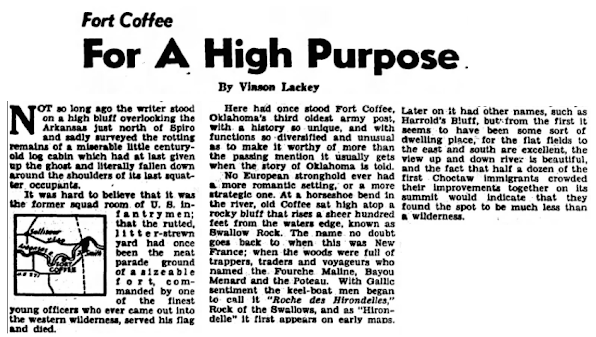
However, the occupation of the area began as military fort. Viason Lackey, a writer for the Daily Oklahoman wrote a fascinating article about historic forts, and on March 13th 1949, he covered the early history of Fort Coffee.


The Daily Oklahoman, 13 March, 1949 page 69
(image cropped for space)


The article which is quite lengthy goes in to much detail about how Choctaw moved into the area early one, followed by white settlers. The issue of alcohol was a major one at the time, and a law was passed prohibiting the establishment of any kind of distillery in the area.


During this time, the larger party of Choctaws had begun to arrive in the same area. The Treaty of Dancing Rabbit Creek was signed and Choctaw emigration to the west had begun. With the arrival of Choctaws into the area, the issue arose again of alcohol, and military was then brought into the area to serve as an enforcement of the prohibition of alcohol.


As the monitoring of alcohol began to wane, troops were sent to the barracks in Fort Smith. Shorty afterwards a major flood occurred on the Arkansas River in 1834. This was one of the largest floods seen since the establishment of Fort Smith. Because of the prevalence of high water, an infestation of mosquitos and the aftermath a new fort on higher ground was constructed.


With the new fort now on higher ground, the ensuing task was the patrol the river, inspecting numerous boats navigating the waster, in search of illegal alcohol. 

After the Fort was abandoned, the site eventually was turned over the Choctaws, who had begun to occupy that area heavily, as a result of the Indian Removal. The Choctaws then established a boys academy. This school was the "brother" school to a girl's academy that had been established in New Hope.


An artist's sketch of Fort Coffee Academy
Oklahoma Historical Society


Interestingly, the article made a reference to the anti-slavery stance that many of the missionaries at the school had taken. Many did not support the practice of slavery by some of the Choctaws, and they shortly left and returned to the north. The "southern branch" of the Methodist Church then ran the school till the end of the war.

Some of the buildings of the old fort became buildings to establish the Choctaw Boy's Academy. One image of one of the buildings was captured in the early 1900s. But not much is known in detail about the layout. What is significant however, was that there was an enslaved woman who was under the "ownership" of the Academy.

The Lone Slave of Fort Coffee Academy
In February of 2019 an article was written about an unknown woman who was enslaved and who worked the grounds of the Fort Coffee Academy. Reference to her existence is found on the 1860 slave schedule a census enumeration of the people held in bondage. The official "owner" of record, was Fort Coffee Academy.


She was on the only enslaved person listed as being "owned" by the school. Was she the reason that the faculty left the school?  As was asked in the earlier article, did she live alone?  Was she near others? Was there possibly another community of enslaved people living nearby?

"It can only assumed that she was cook, cleaner, and tended to numerous tasks that required physical labor at the school. Was she treated kindly? Did she endure sexual harassment in the all male environment of the school? Was she required to also live on the premises? Did she have a room or her own? Did she sleep in a separate cabin?

And, would the privacy of a lone female slave even have been considered? Did she sleep on the floor, near the fireplace? Did she have children and family of her own for whom she pined? If she had children, could she visit them? Or would she have had to wait until freedom came to connect with her own family? And importantly, did she live to see freedom and to breathe free air?

Most of the answers to the questions will never be known. Clearly, s
he was the only person enslaved by the Academy, and a note underneath indicates that she was under the "care" of Rev. Dr. Paine.  One fact is evident, however. Shew as the only person who was a "slave of Fort Coffee Academy."  The document reflecting the enslaved people, has a column where the number of slave dwellings existed on the premises. With her, clearly there is no slave dwelling in which she resided. Did she possibly reside in the home of the Rev. Dr. Paine?

A closer look at the 1860 Population census, in the Choctaw Nation, a Methodist minister named, Frances Paine, is found living in Skullyville. This was the same area location of Fort Coffee. He resided there with a fairly large family.

Chances are that this enslaved woman may have been a "servant" to the family of Rev Paine, in addition to her performing other duties for the academy. And since there were no slave dwellings on the premises, she most likely slept in a small space in the Paine home.


 One other clue about Rev Paine being the same man mentioned as part of the Choctaw Academy, some of the neighbors in the population census are identical to the slave holders on the slave document. In addition others who were enumerated in the same population census page corresponded to the same names of some of the slave holders on the slave census schedule.  

The story of what may have happened to this enslaved woman at the Fort Coffee Academy and her life after freedom is not known, but hopefully her story and other stories will begin to surface as research about the Fort Coffee and other nearby settlements will unfold. 

During the Civil War, most of the buildings were destroyed, and today the old fort site is on private property. 


One site in this old Skullyville area was the Hall Plantation. In 1861 there was a slave uprising that occurred on the plantation. The men in the Hall family were killed by some who participated in the events. However, whatever had precipitated the uprising is not known. The Civil War began around the same time. Jacob Hall one of the enslaved men from the Hall estate, enlisted in the US Colored Troops. The settlements of enslaved people near the Fort Coffee area, witnessed many black Union soldiers coming in from Fort Smith. The 79th and 83rd US Colored Infantries, and the 11th US Colored Infantry was organized in nearby Fort Smith. The Civil War soldier Jacob Hall was a private in the 79th US Colored regiment. He was also the father to Squire Hall, who served as a local deputy in the Skullyville Fort Coffee area.

After the Civil War, many remained exactly where they had always lived, and when the Choctaws signed the treaty of 1866 the enslaved people, finally found freedom. Many who had lived in the Skullyville Oak Lodge, and Braden, and Brazil communities remained in the area. Many eventually lived within a few miles of the old fort, turned academy. Though the school fell into neglect and disrepair, the Freedmen families remained intact. 
Families from the local area became Choctaw citizens after they were given citizenship in 1885. In addition, some families of Chickasaw Freedmen moved into the same area, having to leave hostile and sometimes violent conditions in the Chickasaw Nation. Many married into Choctaw Freedmen families and today some residents of Fort Coffee descend from both Choctaw and Chickasaw citizens.

Before Oklahoma statehood, several neighborhood schools were established by the Choctaw Nation. One of the schools was the Fort Coffee Neighborhood school. A school roster from the old Fort Coffee school was found about 10 years ago. On that roster were children from the Butler, Craig, Colbert, Clayton, Eubanks, Nail, Springs, and Walton families. Two staff members of the school were S. H. Hall, and Moses Parker. Other neighborhood schools were also established in the Skullyville District of the Choctaw Nation.


One of the student rosters from Fort Coffee Freedman School


Today Fort Coffee still exists, but now, as a town with several hundred residents. The Encyclopedia of Oklahoma refers to Fort Coffee, and notes that the old Fort sits on private property. The old ridge known as Swallow Rock no longer exists. Much of the old rock was quarried by the US Corps of Engineers, that was later used to construct the Kerr Lock and Dam. 

But today the town of Fort Coffee is home to numerous families that descend from Choctaw and Chickasaw Freedmen who lived in the area. It is one of the few remaining Oklahoma Black Towns, with a rich cultural tradition and proud people who descend from the community.

* * *

Thursday, May 27, 2021

Chief Gary Batton to Launch Initiative to Discuss Citizenship for Choctaw Freedmen

 "Today we reach out to the Choctaw Freedmen. We see you. We hear you. We look forward to meaningful conversation regarding our shared past."`
                                -Gary Batton, Chief of the Choctaw Nation-May 27, 2021

* * * * *


Chief Gary Batton has released an "Open Letter" on the Chief's Blog on the Choctaw Nation website. It was announced in his letter that the tribe is announcing an initiative to consider tribal membership for Choctaw Freedmen.

It was pointed out in the letter that "this initiative will engage Choctaw Freedmen, the Department of Interior, existing tribal members, our elected officials and membership department officials, and other Choctaw proud in listening sessions to present findings and a recommendation to Choctaw elected officials."

This open letter appears to be quite different from the letter sent to Speaker Pelosi earlier in the year.  This letter also suggests that there is an interest in including Freedmen in the discussions, which had prior to this time never occurred.

The issue of Choctaw Freedmen has had much discussion over the years, in public and private venues, and in recent months, on numerous social media platforms. Choctaw Freedmen like Freedmen of the other tribes, have a history that extends back prior to statehood, the allotment process, westward expansion, reconstruction era, Civil War, and also prior to Removal.  The political history and cultural history of Choctaw Freedmen, comes from a shared history, where people of African descent arrived at the same time as other Choctaws, in the land that later became Oklahoma.

Freedmen from the Choctaw Nation were a bi-cultural, bilingual people, and in some families, bi-racial people immersed into a Choctaw world. They emerged as a people who lived, worked and died as a Choctaw people.

This announcement from Chief Batton, comes at a time, when the eyes of the world are looking at Oklahoma. The 100th Anniversary of the Tulsa Massacre has brought many people to Oklahoma. The national and the inter-national press is now in Oklahoma to cover the events. But in addition to the Tulsa story, some of the journalists are asking questions about Oklahoma's black history, including that of the  Oklahoma Freedmen. There are, as a result, looking at the former slave-holding tribes closely.

The news of the open letter coming out just prior to the weekend events in Tulsa is timely, and it provides an opportunity for the Choctaw Nation to embrace all of its past, and all of the people that are part of that history.

Choctaw Freedmen were those people, once enslaved in the Choctaw Nation.
Choctaw Freedmen were never enemies of the Choctaw Nation.
Choctaw Freedmen freed by treaty, remained there and lived faithfully on Choctaw soil, as Choctaw people.
Choctaw Freedmen were among the thousands who saw themselves as a Choctaws and today they now have thousands of descendants who consider themselves today to be among the "Choctaw proud."

The words of Chief Batton are welcomed words. Freedmen descendants now look and await the opportunity to engage with, listen to, and hopefully to learn from
each other. We are far more alike than not. And after over 100 years, the time has come to engage, again.


Saturday, May 22, 2021

Early Freedmen Population of Boktuklo County, Choctaw Nation


Map Reflecting Location of Boktuklo in Choctaw Nation
(Accessed From www.researchgate.net)

In many cases descendants of Freedmen are looking at records reflecting their ancestors and only know that they were found on the Dawes Roll, but many cannot say much about the community, or who lived in the community in the decades that preceded the Dawes era.  Were ancestors always in the same area? Was there a large or small community of Freedmen in the same area where your family lived? And can you find records showing the names of the ancestors in the years before the Dawes era?

Looking at some pre-Dawes era records might assist you in finding out much more. An interesting set of records can be found on old reels of microfilm from the Choctaw Nation. In the years prior to statehood, there were enumerations of citizens in the nation being conducted. And in the early years right after the Civil War, an analysis was made through a census count in each district of the nation.

Many of these records were microfilmed in the 1970s and can now be found at the many Family History Centers throughout the country. These centers are part of the research centers attached to local stakes of the LDS Church, or Mormons as they are known. The records are also found at the Oklahoma Historical Society in Oklahoma City and they are categorized as CTN records--meaning records from the Choctaw Nation.

In the old Apukshunnubbee District of the Choctaw Nation there are several counties where Choctaw Freedmen lived. Boktuklo, Cedar, Eagle, Nashoba, Towson, and Red River were the counties within that district. While looking at records from the Boktuklo area some interesting census records from the late 1860s can be found. 


To understand how to read the documents the headings are very important.


CTN 13592
Choctaw Nation
Accessed from Family Search, Choctaw Nation Records
Film #166452

In the middle of that same cover page data is contained that represents a total tally of the various categories, such as age distribution and the male to female breakdown. 

(same source as above image)

Turning the page again, the vertical columns are important to take note of and it is clear that Choctaw Freedmen will be reflected in columns 8 and 9. Note the parts of the image below highlighted in red.
Zooming in closely two columns categories of people of African descent are noted--"Free Persons of Color" and Freedmen from States or Other Nations.

(same source as above image)

Both Freed people as well as people those classified as Choctaws "by blood" are enumerated on the same page, but taking note of how the pages are marked those names that have columns 8 and 9 marked reflect those of people of African descent.


(same source as above image)


Some of the pages reflect no persons of African descent those images. In this case sections 8 and 9 do not contain marks of "Free persons of color" nor do they contain marks reflecting "Freedmen from other states and nations."


Meanwhile, there are other pages on the microfilm that clearly  reflect clearly entire Freedmen families. This is shown in the image below.


Although there is no specific year noted on the documents, these records are worth exploring. In addition, if one studies the family groups a rough estimate of the document creation can be made. This can determined roughly when studying some of the persons listed appeared on the Dawes Roll. One should note to see if the children on the Dawes card, were even born when this record was made, taking note of the age of the enrollee at that time. Based on an analysis of other records from other Choctaw Nation Districts, it appears that the records found in the first post-civil war years.

Study the community
Assuming that these records were made sometime before the Dawes era (1898), take note of the number of Freedmen recorded in the community on this record. In this case the community was Boktuklo. Secondly, make a study of the same area during the Dawes era.

How many Choctaw Freedmen from Boktuklo had Dawes cards?
How much had the same community grown within those years?

By pulling up families listed in Boktuklo, one can learn even more about the families that lived there. However, the process will be a tedious one, because it will require looking at every single enrollment card to take note of the Residence and Post Offices used by the enrollee.

It is clear that Boktuklo had a Freedman population in those early post civil war years, and many continued to reside there, through the Dawes era and into statehood. These early records reflect some of that, and all are encouraged to study them to get a glimpse of the first time that the ancestors' names appear on the records as free families in the Choctaw Nation.


Sunday, March 7, 2021

Sallie Walton & Legacy - Women's History Month


Sallie Walton (b. 1863  d. 1968)
Choctaw Freedwoman

Born during the turbulent years of the Civil War, Sallie was born in 1863 the old Skullyville district. Her mother was Amanda Perry who was enslaved by Emeline Perry.  Amanda was the daughter of Kitty, who came to Indian Territory along with the Perry clan from Yalobusha Mississippi, during the Indian Removal in 1831.

Sallie's young years were spent in the post Civil War years in Indian Territory. Her home was in the Skullyville community where she lived the first half of her life. Immersed in Choctaw culture and language she adapted to the life that surrounded her. As a young woman she  had a child with John Williams and daughter Louisa was born.  In 1883, she married Samuel Walton in the Choctaw Nation.


Samuel & Sallie Walton

Sallie's life before that unfolded in the  Skullyville area. Her immediate family was not a large one. Her grandmother Kitty Perry Crow, was the head of the family and during those years they maintained a relationship to the Perry's who had brought them to Indian Territory in the 1830s. Sallie was close to her mother Amanda as well as to her uncle Jackson Crow. During t he years of post Civil War Indian Territory, the family lived in the Choctaw community around Oak Lodge.

Family Saga Jackson Crow
Sallie's mother Amanda Crow had a brother Jackson Crow. Often called Jack by the family, he came of age in the small Skullyville and Sugar Loaf communities in the Choctaw Nation. Her uncle Jackson Crow spent time with other young men in the same area. They were the closest neighbors, and he was the only Freedman in his circle of friends. It was his group of associates who encountered local Choctaw Charlie Wilson on a road in the same area. Wilson was running for a tribal office at the time. During the encounter with Wilson a confrontation unfolded, and Charlie Wilson was left dead. Although there were several of them in the group, Wilson's death lead to the arrest of Sallie's uncle Jackson Crow, who was the only one in the group arrested and later tried for the death of Charlie Wilson.

Although it is said that the gun that killed Jackson Crow was not his, he was still the only one tried for Wilson's death. He was also the only "Choctaw Negro" in the group, he was convicted and executed in Judge Parker's court. The impact of the capture execution of Sallie's uncle left a dramatic impact on the lives of the Perry women, so much that Sallie often resisted ever speaking about it, when asked, and the few times she was known to raise her voice came when she adamantly refused to revisit the trauma, which occurred when he was captured.

The capture involved setting a fire to the family cabin. Three women were inside the small cabin at the time. Sallie's mother, grandmother, and Crow's wife were the likely three women, terrorized by the blaze, and in fear of being burned alive, the three women were said to have fled the cabin in tears and terror. Sallie, living nearby with husband Samuel Walton had to have been equally shaken by the sheer experienced by her mother and grandmother.

Attending the trial Sallie and her family would only be present to claim the body of Uncle Jackson Crow after his execution. Sallie retreated to a quiet life in the Territory. The notoriety of being related to "the outlaw" who was her dear uncle left an imprint on the Perry women.

Life in Skullyville
Sallie who had married in 1883 lived quietly in the nation with husband, Samuel Walton who was a well known preacher in the Skullyville community. In the years after her uncle died and the notoriety had subsided in the area life continued for the family amid their heartbreak but she had the comfort of her husband Samuel. 
Sallie's grandmother Kitty died in the late 1880s and her mother passed away in 1898. By the early 1900s they'd had two sons Houston and Samuel Jr. Sadly, Houston, her oldest son would perish in a train accident in 1904. A few years later in 1912, her husband Samuel passed away, and was buried in the Hontubby area of Le Flore County.

In her younger years, Sallie had not had access to primary education, but both she and her husband Samuel who was a literate man, both emphasized education for their children. Settling in the Ft. Coffee area for a few  years, their son Samuel attended the Fort Coffee neighborhood school for Choctaw Freedmen children. In later  years, when Samuel married a woman from nearby Arkansas, they would move across the state line so that the Walton children would have access to schools for black children, in nearby Fort Smith. Sallie would eventually join them in nearby Fort Smith, right across the state line, in Arkansas.

Sallie continued her life in Fort Smith for the next 40 years as a widow, nurturing her grandsons, choosing to become a member of the First Baptist Church. It was a coincidence that she joined this church, because her husband Samuel had contributed to building that church, in the early years after the Civil War, and helping to establish the first "Sabbath" school for freed blacks in the city.  
Sallie became a beloved grandmother and great grandmother to the Walton family of Fort Smith, and the Sanders family in Le Flore County Oklahoma. She was an active member of First Baptist where she attended until latter years when her health required her to slow down. The pastor however, frequented her home in Fort Smith giving her communion and praying with her.

She maintained a strong identity to Choctaws in the Howe Oklahoma area, and also made inquiries in the early 1920s about her own history and past by communicating with locals in Le Flore County area, in Howe. W. B. Billy and Loman Jack in the Howe area communicated with her in the 1920s. 

Lands that were allotted to the Walton family, were now long lost to the family and she now lived with her son and his family. But both Billy and Jack communicated with her from nearby Oklahoma. Both of these Choctaw men, had known her parents and shared much of her family history with her. Her interest in history, land and culture were pervasive throughout her life. 

After locating to Fort Smith, Sallie's to live with son Samuel and his family, she insured that the Walton children would have easier access to education.  She became a lifetime member of the Baptist church, and spent the remainder of her life there. Her lifestyle was a simple one, where she tended to a large garden, working on her long treasured quilts, and prepared simple food dishes or drinks from her Choctaw life---Pashofa, Tom Fuller and "kvfi". 

Sallie was always the matriarch of the family instilling a strong sense of family, emphasizing both education and independence to her children. 
Her meager funds were often used to buy books as needed for the grandchildren, who attended local parochial school for black children.

One of her older grandchildren, Ethel Sanders, who later migrated west to California, remembered how her grandmother Sallie was frequently teaching her words and phrases in her native Choctaw language. During the 1950s Sallie's younger brother Joe Perry came to visit, and an uncle reminded me, of how he was in awe listening to the two of them talking on the back porch in their native Choctaw to each other. Before her health declined, Sallie was an avid walker, often walking for miles, especially when items were needed for her garden and property. 

Her grandchildren and great grandchildren in both Le Flore County Oklahoma and Sebastian County Arkansas would frequent her home well into the 1950s  In 1961 her health declined and she passed away peacefully in July 1961 in her home in Fort Smith.

She left behind her a the treasured Bible, several of her handmade quilts, and a few images of family and loved ones. She is buried in Oak Cemetery in Fort Smith, near her son, Samuel Walton Jr.

This gentle Choctaw woman was my great grandmother and she was my heart. May she ever rest in peace. I honor her during Women's History Month.


Monday, January 4, 2021

Choctaw Freedmen at the Dawes Comission

When and where did Freedmen go to have their families interviewed in front of the Dawes Commission? 

Many people assume that everyone was interviewed in the same place. And in many cases it si assumed that Muskogee was the site. However, that is not the case. There were specific places where the interviews were held in each of the Five Nations.  In some cases the site was near the family's home, but in other cases people had to travel by horse, or wagon to get to the enrollment site and camp there for several days before appearing before the Dawes commissioners.  

In early 1899 notices were put up throughout the Choctaw Nation to inform the public of the plan to accept applications for through the Dawes Commission. Choctaw Freedmen were included in the registration process. And in many Dawes files the interview site is mentioned as it was often mentioned in the transcription of the family official interview.

A document recent found in the Congressional record refers to the schedule for citizens of the Choctaw Nation. Here is the schedule as shown in the record:

Excerpt from 
60th Congress 1st Session, Senate Document No. 505 p. 14


Enrollment Sites:
Alikchi  April 18-May 4, 1899
Goodland May 8-May 12, 1899
Antlers May 15-May 19, 1899
Tuskahoma  May 22- May 26, 1899
Talihinia  May 29-June 2, 1899
Wister June 5-June 9, 1899
Oak Lodge June 12-June 16, 1899
Red Oak June 19-June 30, 1899
Hartshorne  July 3-July 7, 1899
Calvin July 10-July 14, 1899
Durant  July 17-July 21, 1899
Caddo  July 24-July 28, 1899
Atoka July 31-Aug 11, 1899
South McAlester  Aug 14-Aug 25, 1899
South Canadian  Aug 28-Aug 31

This information can illustrate how the enrollment process must have caused much excitement as well as anxiety for the enrollees. Some had to travel while others who lived nearby saw a large influx pouring into their communities.  Some of the images that are reflected are quite indicative of the activity this had to have caused for families.

Hundreds of people filed into the places established in the local communities over a 4-5 days period. It was not clear the order in which people were taken once they arrived at the enrollment site, but many did await their turn to enter the tents outside on the enrollment camp site. One photo, familiar to many shows a group of Choctaw Freedmen awaiting the process to extend to them.


Choctaw Freedmen Awaiting Ernollment
Courtesy of the Archives & Manuscript Division of the Oklahoma Historical Society


The many hundreds of people awaiting their turn to enroll had to have brought about an atmosphere of excitement and energy. Some took advantage of the many people pouring into the communities by selling products and wares to the oncoming crowds. One image captured Freedmen setting up a small make shift stand to sell clothing to passers by.

Freedmen Camped at Ft. Gibson
     Aylesworth Album Collection, Oklahoma Historical Society

The entire enrollment process took more than ten years to complete. The rolls first closed in 1907, but then reopened to add a few more that had not been on the original roll. They were finally closed in 1914. There were over 20 thousand freedmen enrolled after the process had ended. 

When the final roll was closed, in 1906, there were 91,637 from all of the categories of the Five Tribes.
The total number of Freedmen in Indian Territory in 1906 was 20,766. (Cherokee Freedmen numbered 3982. Creek Freedmen numbered 5585. Chickasaw Freedmen numbered 4995. Seminole Freedmen numbered 857 (with 93 added later). Choctaw Freedmen numbered 5254.)

Freedmen from the Territory made up more than 20% of the Dawes Enrollees. Their presences and multigenerational presence in the nations, has them not only firmly planted on the soil of Indian Territory, but also strongly attached to the nations of their birth. Choctaw Freedmen. From Alikchi to Atoka, from Tuskahoma to Talihina, they were there. Their presence through their having been brought there, toiled there, and died there earned them the right to the citizenship long denied. The struggles of their descendants continue to this day.


The Story of Nancy Ishcomer-Shields

Community, Culture & Identity: Nancy ISHCOMER-SHIELDS, Choctaw by Blood-African Indian

by

Terry Ligon, Guest Author

I can’t help but notice discussions by some Native Americans concerning concepts on “culture, community and identity. Included in those discussion are the “traditional” ways of life within their tribes. While conducting my latest research these issues became part of my back story as I attempted to locate the “numerous Indian Negroes” on the Dawes “Choctaw by blood” roll.


As I went through the Dawes cards and identified about twenty individuals and then their subsidiary genealogical lines, I wondered what their census information was and how they identified themselves to the census enumerators. Certainly this could not tell me about their culture but it might give me insight into how they view themselves (identity) and determine the people that made up their “community.”

Tams BIXBY acknowledge there were children of “mixed” black and Indian parents on a Dawes card that identified them as Choctaw Indian. I have questions about what happens a few years later when the first Oklahoma federal census is taken and how “Indian-Negroes” identified themselves?

What was the community like in which they lived? Was it mixed freedmen, white and Indian? Did they reside in a strictly Native community practicing their “traditional” customs and culture or did they begin to identify themselves as black, colored, or mulato? There were Indian Census Schedules that were used to identify Native Americans, would I find them enumerated on one of these schedules?

If you will recall, Tams BIXBY gave two examples of “mixed Indian Negroes” placed on the blood citizenship rolls. In my first blog on the subject I discussed Beulah MARSTON and his children.

http://blackandredjournal.blogspot.com/2010/12/numerous-cases-of-mixed-indian-negro.html

In the second example given by BIXBY was a family by the name of SHIELD(S). This family as the other appear to be a great example of how complex the issues of identity and family have evolved among the members of the Five Slave Holding Tribes.


The common factor with all of these “mixed blood families” was their father was considered a black, colored or freedman and their mother a Choctaw blood Indian. I began to question what did they consider themselves after being enrolled as a Choctaw by blood? Did they intermarry with other Choctaw’s or did their children continue to develop relationships with blacks? Another important issue would be how were they treated by other Choctaw blood citizens? The other factor that had to be critical to their relationships was the laws enacted in the nations that forbade “intermarriage with anyone of African descent.”


Nancy seems to make a conscious choice of marrying a freedman and her some of her children seem to have made a similar decision when you look at additional records.


You will note the Dawes allotment card for Nancy indicates her husband and the father of her children was a “colored man.” Utilizing the notes on Nancy’s card I am able to locate “New Born” cards for another child of Nancy’s, as well as two children of her eldest daughter Sarah. These cards are important because they provide information on the names of the children but also information on their father’s.


In terms of identity, it is interesting that in the 1900 census Nancy and everyone in her family were enumerated as being black. However, Nancy and her daughter enrolled their children in the Choctaw tribe as Choctaw by blood as a minor or new born in 1904, ’05 and ‘06.


Clearly they understood the importance of enrolling and documenting their children as Choctaw by blood. I would assume they did so in their efforts to secure more land the children would be entitled?

Without personally knowing any descendants of the SHIELDS it is difficult to say if they have maintained their Choctaw identity or become black as a result of their marriages to other blacks. Ten years later the 1910 census provides us with additional clues as to how they were perceived or identified themselves.


In the 1910 census we see the older children grown with families of their own. Despite the fact there are “Indian Population Schedules” for the 1900 and 1910 census, none of the SHIELDS family is enumerated on them. The assumption here would be they are not looked at as being Indians but now mulato.


What relationship they had to other tribal members is not known but now they lived in the state of Oklahoma and racial categories were an integral part of the life that being black brought about issues that you think the SHIELDS’ would avoid if possible?

I thought this would be the end of this little research on identity, culture and community but this family got a lot more interesting the more I followed the extended family and ancestors of Nancy ISHCOMER-SHIELDS.

I will post that in the second part of this fascinating research exercise on the ISHCOMER & SHIELDS family!!!


Sunday, December 13, 2020

Still in Bondage After the Civil War in Choctaw & Chickasaw Nations

 "But to our sad disappointment the war is now apparently ceased and a general peace among the white and red man is agreed upon, and generally adhered to, by those two races, and yet our dear ones are still held and and tyrannized ever in a most cruel manner, by their former masters. Since the right of property in our race has been abolished by the US Government, the master have become brutal in their treatment of our color...."

   -Excerpt from letter written to the Freedmen's Bureau by former slave from Indian Territory-

* * * * *

In October 1865 a full six months after the end of the Civil War, men who served in the Union Army and who fought for their freedom, found life to be challenging in those times.  Several turned to the Freedmen's Bureau Office in Washington DC for assistance.  Their goal was to get to their families and to begin their new lives as free people. But the letter which was eventually sent to Washington DC headquarters explained the problems that they encountered in Indian Territory.

The letter was a poignant and a sobering one, and clearly the basic desire for freedom and to make choices that affected one's life burned in the chest of all men, and women. The letter is a touching one and a true reminder that slavery, no matter where it occurred, was a horrific condition to impost upon others.  And after the conflict that brought slavery to an end, the lesson is that clearly slave holders tried to hold on to their free labor force as long as possible. This letter from Indian Territory reflects that time.

The letter was followed by the list of names of the men and their families still held in bondage. This list of names, is possibly the first list of names of enslaved people from Indian Territory, and because these families were still being held in bondage, it is a rare letter listing the names of people prior to their release from bondage among the  five slaveholding tribes.

 Most of the letter spoke of Choctaw and Chickasaw nations, but one of the signers was also from the Cherokee Nation as well. The men had served in the Union Army, including the Indian Home Guards, and the US Colored Troops.

State of Arkansas
City of Ft. Smith

                                                   October 12th, A.D. 1865
                                                    
To the Honorable O. Howard 
Superintendant of the Freedmen's Bureau
Washington D.C.

Sir:

We the petitioners would respectfully represent to your honor as follows: That at the commencement of the late rebellion, we resided in the Indian Country, and were held as slaves by the Chocktaw (sic) and Chickasaw Indians, In different locations in the Territory and during the progress of the War we made our respective escapes from bondage to the Freedom of the Federal lines, but left our wives and children, fathers and mothers and sisters behind still to endure the severity of their savage masters or "till sometimes as the fortunes of war should bring them relief" as we had hoped.

"But to our sad disappointment and regret, the war is now apparently the war is now apparently ceased and a general peace among the white and red man is agreed upon, and generally adhered to, by those two races, and yet our dear ones are still held and and tyrannized ever in a most cruel manner, by their former masters. Since the right of property in our race has been abolished by the US Government, the master have become brutal in their treatment of our color...."

Under the leadership of Daniel Loman from the Choctaw Nation their letter was directed to the Bureau headquarters. It should be pointed out that six months after the war ended, those once enslaved found themselves still in the struggle for freedom. It was apparent that slave holders were not too anxious to allow their former human chattel to have their hard earned and long desired for freedom. This letter penned in October--half a year after the war ended, it clearly illustrates that some were still being held in bondage.

The letter was followed with lists of the families of the men requesting assistance:


Signers of the Letter to the Bureau for Assistance

Signers of the letter: Buck Bushyhead, Watson Brown, Grundy Thompson, Wilson Thompson Isaac Kemp, Andres Chief Watkins, Ben Colbert, Randolph Gardner, Jerry Kemp, Henry Kemp, John Fisher

*

Families needing release from bondage:

Family of Watson Brown (Interpreter) Wife Harriet Brown, Child Minny Brown
Family of Daniel Loman (Farmer) Wife Sophia, one child, Robert Loman. Also sister and four children. (Sister's name  Nancy Harrison, children's names Isaiah & Sary and Lisa & Buck
Family of Ben Colbert  Has mother and two brothers. Mother's name Rachel Colbert. Bors names July & Mobeal (sic) Colbert. One sister Nancy Colbert.
Family of Grundy Thompson (Blacksmith) Wife Rachael Thompson
Family of Hanson Thompson (Blacksmith) Five Children Mahaly, Henry Angeline, James and Rachel
Family of Wilson Thompson (Farmer) Wife Elizabeth, one child (Infant) Mother jane Thompson and two brothers William and Pompey Thompson
Family of Randolph Gardner (Boarding House Keeper) Mother 3, nieces, 1 nephew. Mother's name Tennessee Gardner. Nieces names Laury, Missa & Jane Gardner. Nephew's name John Gardner
Family of Isaac Kemp. Wife and one child. Wife's Name Susan. Child's name Elizabeth. Also a mother Frances Kemp and her children, 4 in number. Frances, Mary, Charles & Elijah Also a mother in law named Lucy Colbert, all reside in Chickasaw country, Chickasaw Nation.
Family of Jerry Kemp, (Blacksmith) Wife and 4 children. Wife's name Frances Kemp. Children's names Francis, Mary, Charles and Elijah
Family of Henry Kemp. Wife and 3 children. Wife's name Caledona. Children's names, Leroy and Leander and Infant
Family of John Fisher. Wife Ellen and child names Alexander. One sister named Emily Fisher. Two nieces named Isabella and Perly(?)  Fisher. Also Father and Mother names John & Nancy Kemp and their children Moses, Dickson, Betty Adeline. (?) and Francis Kemp. And a sister and her child Frances Kemp and her children Mariah and Iverson and Ben and Thomas and Johnny Kemp and infant.


Close up of  letter listing Indian Territory Still Being Held

It is not known when the families were finally released from bondage. But it is clear that similar to the lives of freed people in the deep south, those who were once enslaved in Indian Territory clearly had many challenges facing them. The act of reuniting with families was denied for many months after the war.

The following year, the five slave-holding tribes (Cherokee, Choctaw, Chickasaw, Creek and Seminole Nations) each signed the Treaty of 1866, which officially abolished slavery in Indian Territory. The Choctaw and Chickasaw Treaty was signed in July 1866.

Epilogue

Recent claims from the Chickasaw Nation today have stated that their enslaved people were freed right after the Civil War, however, the institution clearly continued for many months. Their own leaders did not abolish the peculiar institution until July of 1866 a full 15 months after the Civil War ended. However, their website states that slavery came to a "full and formal end" at the end of the Civil War. 

In 1866, the Chickasaw Nation signed the treaty that "fully and formally" abolished slavery, a year after the war ended, And, the nation also agreed to give citizenship to their former slaves. But they did not honor the treaty, and felt justified in denying citizenship to former slaves---yet they had no problem with holding them as human property. They signed a treaty in 1861 with the Confederate states, and fought for the south, and like many in the deep south, they were not eager to abide by the 13th amendment in the US that abolished slavery in the states. A since they were not in the United States, clearly slavery continued.  

Slavery was abolished by the signing of the Treaty of 1866, and it did not end in 1865 as stated on the website on Chickasaw.tv 

Sadly for the Freedmen, once freedom came, their place in the nation of their birth was discarded, and the position against this newly freed population who toiled for generations, was one of disdain, mistreatment and disenfranchisement. This anti-black policy holds till this day against the descendants of African Chickasaw people. They welcomed Africans as slaves with no rights, and once freed after generations of bondage---the same nation extended no rights of any kind nor assistance of any kind, to them when they were forced to abolish this institution of horror.

No voting rights,  no citizenship, no schools, no amenities, no assistance. This is their history and the stain upon their narrative.

The Freedmen in the Chickasaw nation  were, as scholar Daniel F. Littlefield pointed out, "a people without a country". They remained without a country until Oklahoma statehood in 1907.  

As slaves, they were never "forced" upon the Chickasaws, but clearly as freed people these African Chickasaws were discarded and ignored, while they practiced the Chickasaw culture, spoke the Chickasaw language and lived in the Chickasaw Nation---the land that was the only world that they knew.

And sadly this anti-black sentiment continues, towards the descendants of these African-Chickasaw people, while an effort is made to "soften" their history with mis-statements.

The claims of "blood" are often made to somehow justify their policies.

But if holding the slave holder's "blood" was the ticket to citizenship then 4 million African slaves in the US would have also been without a country. Citizenship should never be based on having the oppressor's blood. Such policy establishes a caste system, and places the stain on slavery upon the victims of the oppressors and banishes their descendants into a state of non-existence and alienation in perpetuity. 

Today one finds on Chickasaw.tv the following:


From the website of Chickasaw.tv

The statements above reflect incorrect facts about slavery in Indian Territory and in particular the Chickasaw Nation. Douglas Johnston, related to Cheadles on his mother's side, who were slave owners, would address the status of Freed African-Chickasaw more than 30 years after the post Civil War mistreatment began. The post-Civil War practice of keeping the Freedmen locked out of everything, from education, and rights had, in fact, become a Chickasaw tradition. Many struggle to analyze this practice of disdain, and many have chosen to study the history in many circles today.

In addition, there is a larger story, including telling the history of African tribal Freedmen from all of the slave-holding tribes. There is a rich history that deserves to be told. All of us are encouraged to seek and find and share these long forgotten stories and study their history and put it back on the historical landscape from which it comes.